
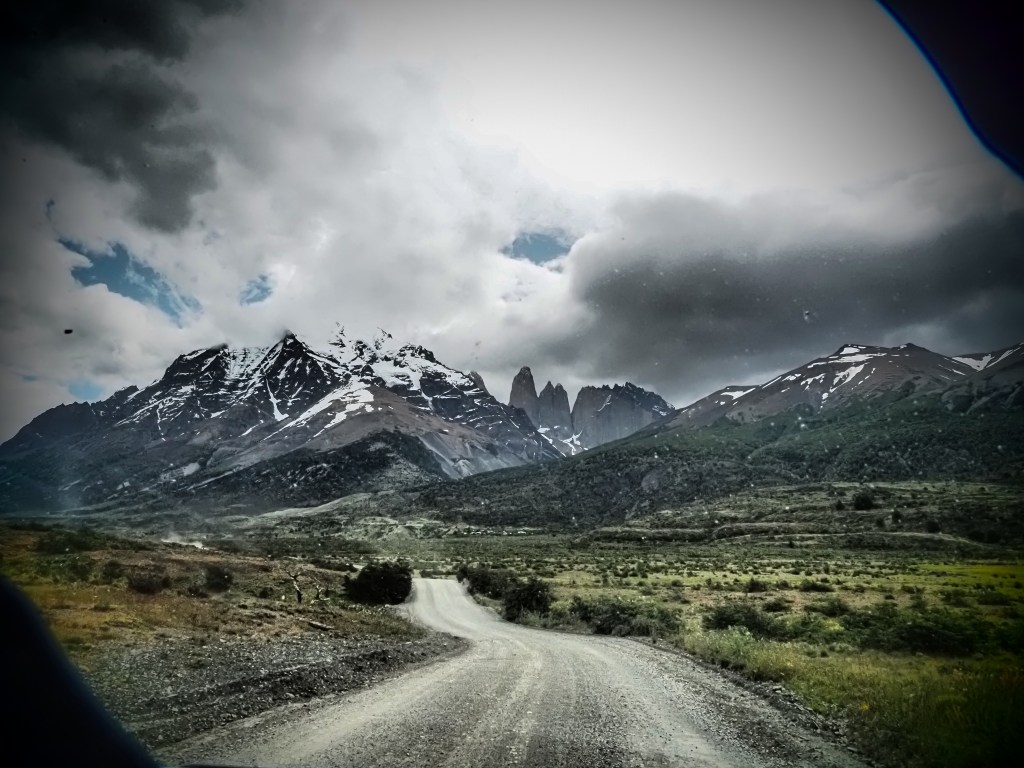
Over six months ago I started working on a photography excursion with my friends, Joe and Mary Ann McDonald at McDonald Wildlife Photography, to Chile in South America. I had been seeing photos of the Torres Del Paine National Park, located in Southern Chile (Patagonia), and had found myself enamored by the sheer beauty of the landscape. Then I discovered that the area in and around the park is lousy with wild Pumas (what in North American we call “mountain lions”). I was hooked!!
The photograph above was taken through the windscreen of our four-wheel drive Mitsubishi Monterro. Great car for an absolutely amazing ride into the park!
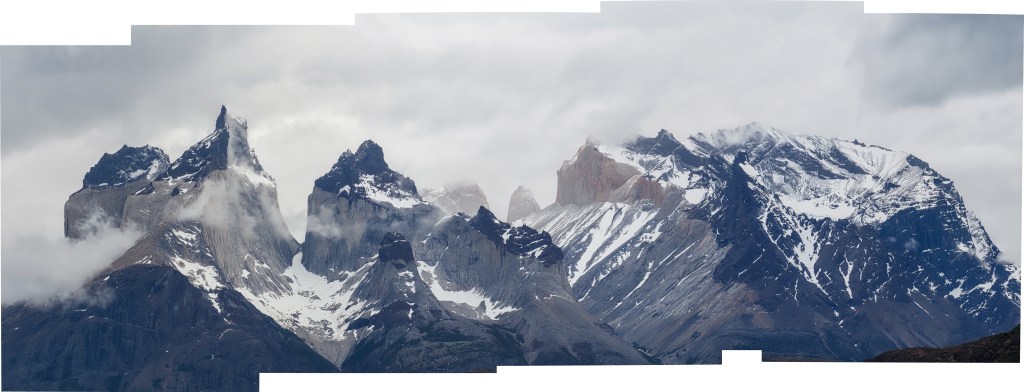
The picture above is a panorama of the Torres Del Paine Massive, looking to the east. This is a composite of five photographs (hand-held) and stitched together in Lightroom Classic. Left and center in the composite are the rock pinnacles known as “The Horns”.
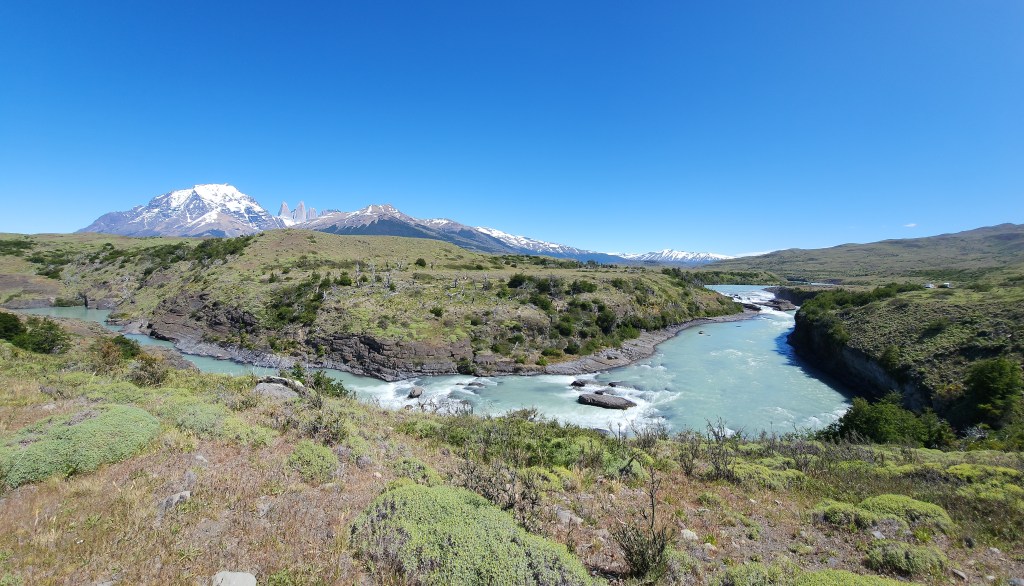
I truly love taking panoramas of vistas like this one at the Paine River Falls, on the southern edge of the park. The river is that aqua color due to the colloidal sediment created by the glaciers grinding across the rock base further up the river.
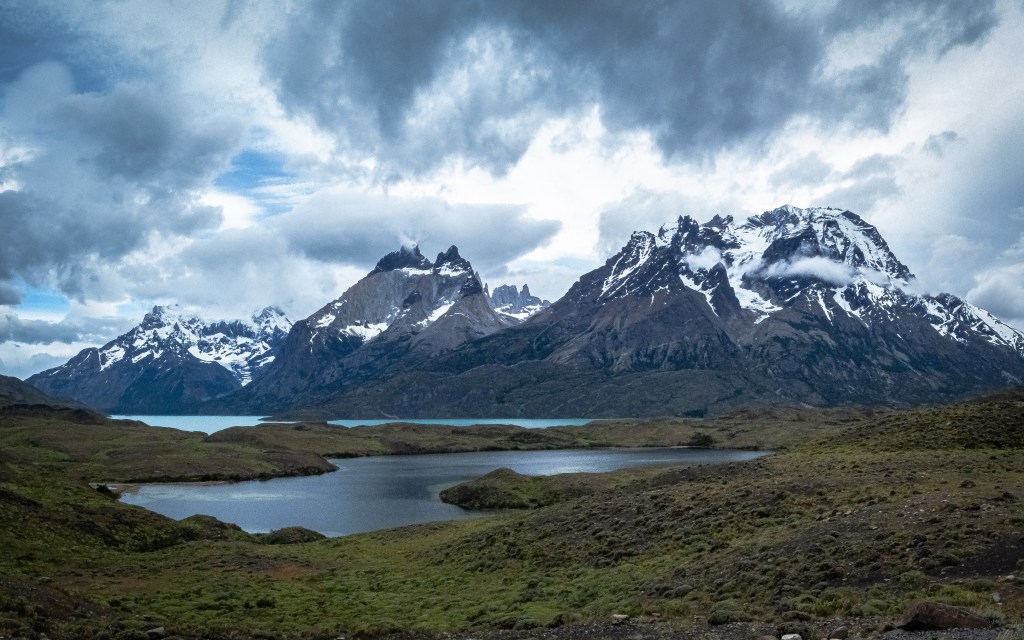
December in the northern hemisphere is summer below the equator. Temperatures here ranged from -2 C to a high of 12 C, which may sound warm until you factor in that there is almost never a time when the wind is not blowing from the west or northwest. We actually had some very nice weather with only spotty rain and a frosty morning. Another photo looking north-east towards The Horns.

Most of the time spend “walking with Puma” was done on the neighboring estancia, a family owned area of about 14.5 K acres that had previously served as a sheep ranch. Today, due to the work of a few people from around the globe, the ranch is now a sanctuary for wildlife to grow and thrive upon . . . especially the native Pumas! This is a picture of the area known as “the Hotel” and is a known hangout for the big cats.
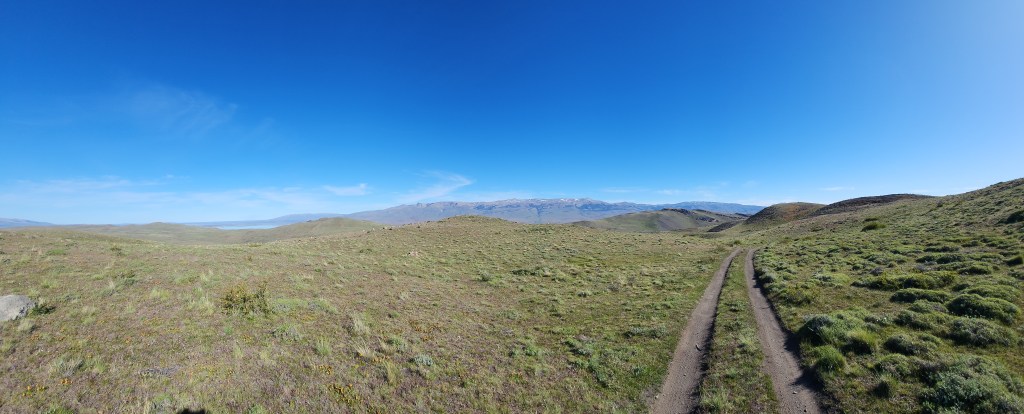
In the past, when you “walked with Pumas”, you did exactly that . . . you walked . . . a lot!! Today, the estancia has built dirt tracks into and around the rolling hills to make access to the Pumas and other fauna and flora simpler, but the Pumas rarely seem to loiter near the roads. Additionally, last year was a very hard winter, and the road are almost unpassable now with only four-wheel drive vehicles allowed into the ranch.
It should be noted that the Chilean Government and the owners of this estancia, as well as the other 15 surrounding estancias (all 16 are now sanctuaries for the Pumas), have strict guidelines for entering and using the land. In the National Park, you may only hike and camp on the designated trails. Violators are not tolerated and the fines are substantial. This is done to limit, as much as possible, damage to the environment caused by what Americans now call “Tourons”! (I was amazed that this term is used by the people in Chile to discuss the ugly tourist type Somehow it will make it’s way into the Webster’s Dictionary in a year or two! LOL)
On the estancia, only authorized and certified Outfitters and Trackers are allowed entry. The time on the estancia is controlled, and if you enter in the morning you must be off the ranch by 11:00 AM. You cannot return to the ranch for at least five hours, and exit time is sunset. The time limits are established to limit the impact and intrusion on all of the wildlife and to give them a chance to relax and rest. Additionally, there is NO OFF-ROADING to chase Pumas. If the Pumas stalk off . . . well . . . you are “walking with Pumas” and hopefully enjoying the fresh air and copious amounts of amazing scenery! And . . . do not be seen harassing the wildlife or doing anything that even resembles harassing the wildlife unless you want to be forever banned from the estancia . . . a simple rule . . . and one that our National Parks should establish as well!
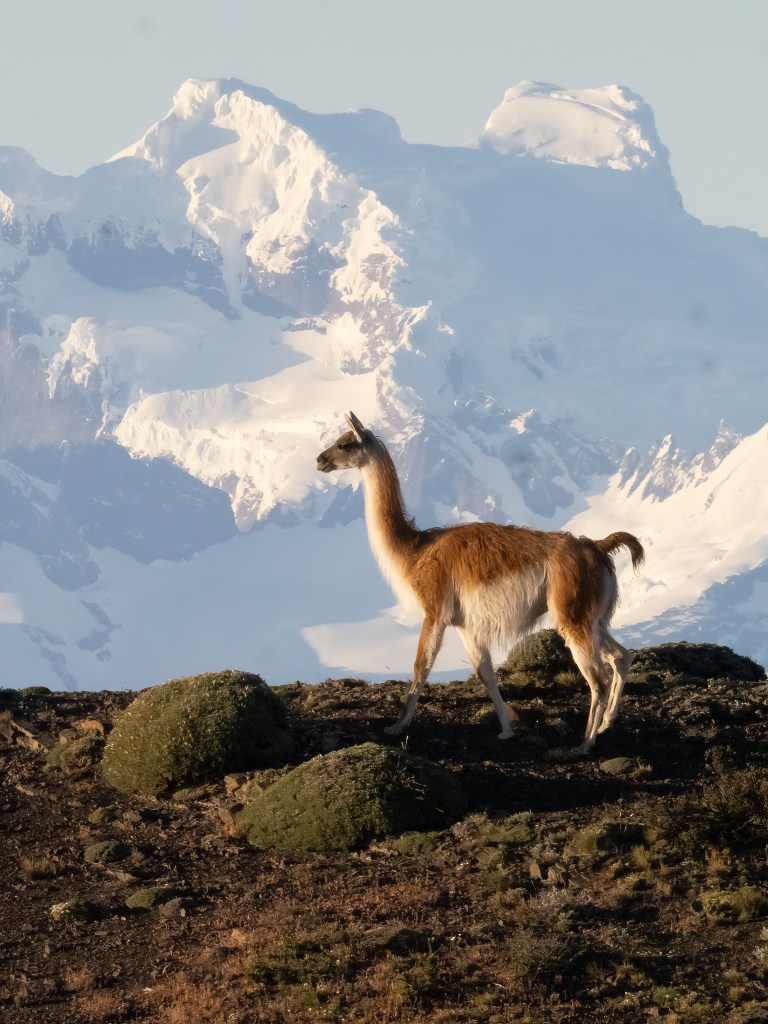
The Guanaco of Chile in an iconic photo with the Andes in the background. There are easily hundreds of these very photogenic creatures on the estancia and Park so one might think that getting this picture would be easy. ITS NOT!! Guanaco do not like to stand still for long and are constantly roving in the search of their newt cud of grass. They tolerate humans, but the start of summer is the birthing season, and new Moms are very shy when it comes to letting anyone too close to their kids. When you see a herd of Guanacos heading to a ridge where you might be able to get this shot . . . you need to be flanking them and getting ahead so that the Guanaco walk into the composition . . . and many times they will see you and either stop or change direction so your ambush photo is a failure!!
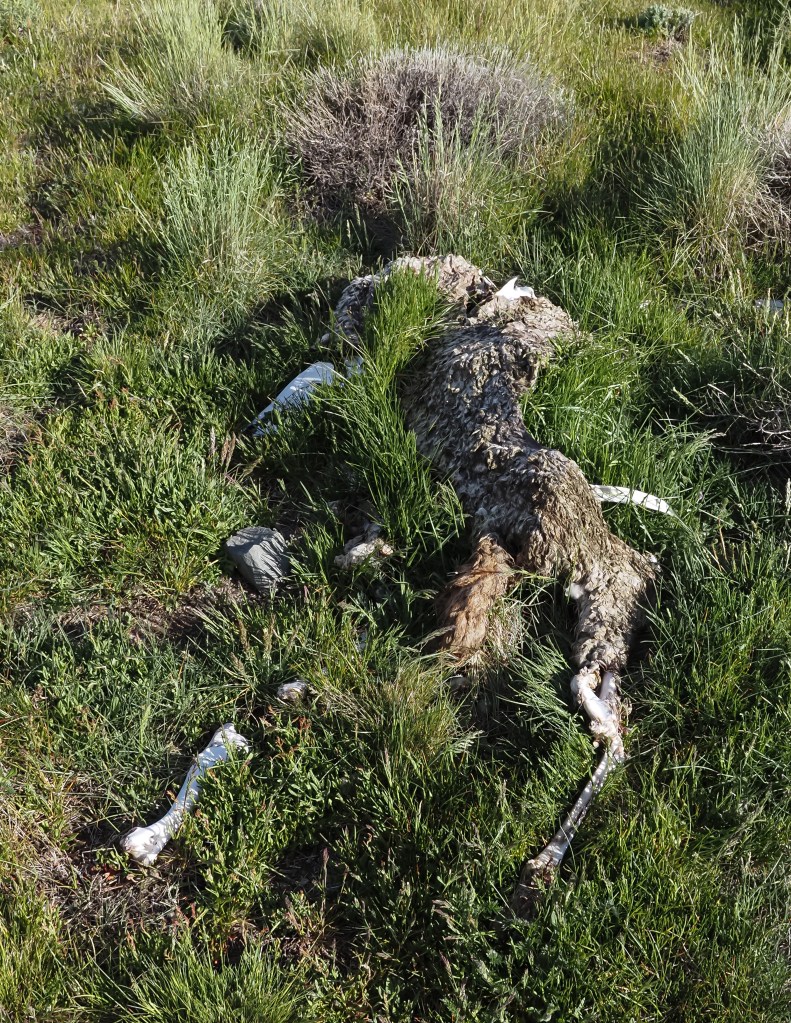
Guanaco mortality is rather severe. Carcasses, like this one pictured, litter the landscape. This one is probably this years kill, but the bones will stay. bleaching in the sun for a decade or longer. Fear not . . . there are plenty of Guanaco to go around, and when the Guanaco are scarce, colonists in this reason decades ago released European Hare into the wild as a game animal . . . and it is a perfect supplement to the Puma diet!
I will always tell you that wildlife photography is a balance between a couple very simple steps in the overall process. First, knowing and researching your target animal BEFORE you head out into the field, then patiently studying your target animal once you find it in the field to learn how it is living and working in the environment (having the ability to comprehend and implement basic tracking skills helps!) and learning to read the animal so you can gauge its direction of movement as well as the animals “flight or fight” instinct (how close can you work to the animal before it either runs off or charges at you.) Even if you are with a small cadre of photographers, this step is important because it will aid you in where and how you position yourself in your pack. Your tracker and outfitter may get you to the animal for good photos, but knowing and applying this step is important to go from “good’ photos to “GREAT” photos.
The second step, I believe, involves your individual skill that you have developed with the camera gear you carry, regardless of the make (I was a Nikon enthusiast but am now strictly an Olympus kind of guy!) This step should be intuitive to most people and it should be easy, but in the heat of the moment . . . when the target animal is at a perfect range and in perfect light, about to do that one action that even National Geographic has never caught yet . . . you need to be able to remember such mundane things as composition of the shot (are you zoomed in too close or not quite enough), change in light as the animal moves across the spectrum, to check your ISO, is your shutter speed too fast or too slow, or is your depth of field only going to give you a sharp focus on the animals nose and nothing else!
How does one fix all of this? All I can say is “Practice, practice, practice some more and then prepare yourself (mentally) and your camera gear (physically) the night or day before entering the field. If you do this (and add in the final step which I will discuss next) you will ultimately have a photo or two that you will be incredibly proud of having captured. However, even with this being said, there is not a photographer out there who has not jumped out of bed, gone into the field and found their battery is almost dead and they have no spare, or that has downloaded their memory cards the night before and somehow forgotten to put them back into the camera. This is where the final step is crucial!
The third and final step, if you complete step one and two above, is easier but almost totally out of your control. Steps one and Two have prepared you to make the best of Step Three but no one can say when or how it will be revealed. Step Three is purely LUCK! You can (and will) study and prepare to see an animal, know all of its flight or roaming habits, where and when and what it eats, when it mates, when it sleeps and where, when it will have little animals and bring them out for you to see. You will know this!
You will know every button and setting on your camera of choice. You will have worked you selection of lenses in every light, in every focus range, and probably in every weather condition.
Yet, when KARMA decides to present you with a scene in the wild, wild, world of nature . . . something that we have all only dreamed of (or never even knew could occur!) That is when, if you are lucky, it all comes together. Viola!! You look at the image you have captured on that little screen on the back of your camera, your heart soars in seeing that you have recorded that microsecond in time . . . and it is sharp and clear and wonderful!!
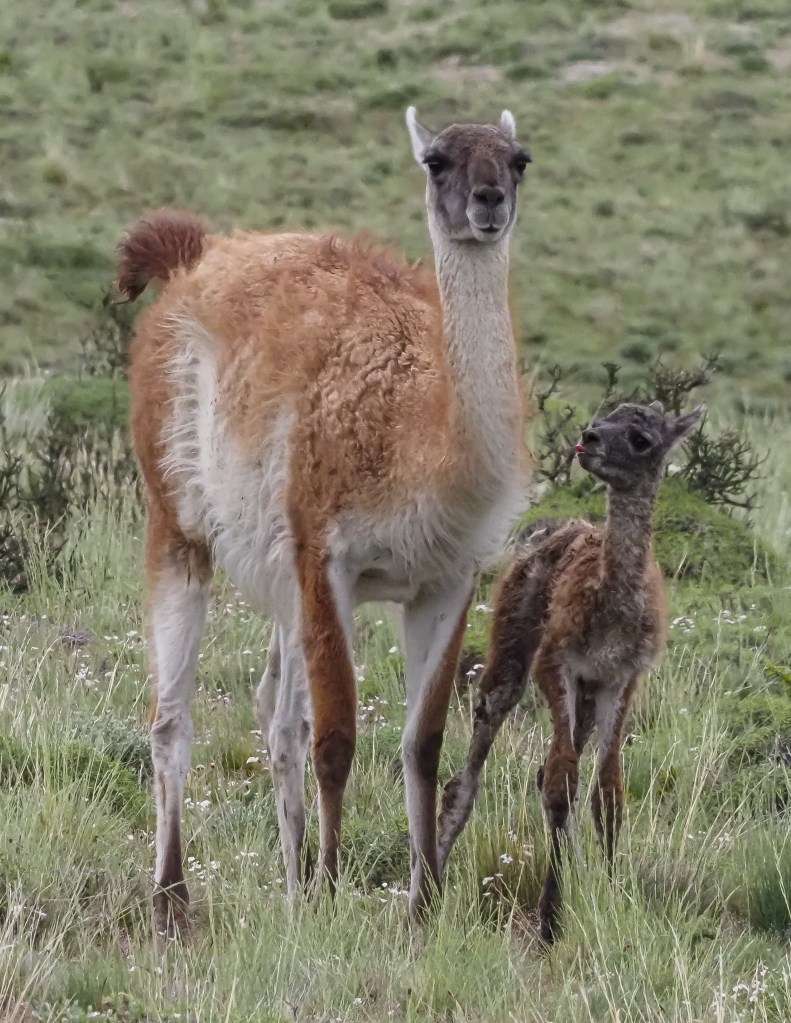
The previous picture of the mother and little Guanaco was one of those moments for me. In reality it was about 20 minutes of moments but I digress. We had been looking for a lone Puma that was supposed to be in one section of the estancia to the southwest of the Hotel. As we drove over the ridge, down in the small valley was a herd of about five or six Guanacos. One of the female Guanacos had a baby Guanaco head and two front hooves extending from the birthing canal . . . right in front of us. Out of the vehicles and into the pampas we went . . . but not too fast or too close since scaring a mother while she is giving birth is probably BAD!
So . . . we took are positions and started to watch as the mother first laid down and then stood up, walking in circles as the baby slowly emerged. Finally, as the baby dangled from the mother, one big push, and out dropped a baby Guanaco on its head!! It was probably only at 0 Celsius with a ten mile an hour wind, colder than I wanted and definitely colder than I would have wanted any mom to give birth to a wet, shivering baby anything!
So, that was a cool photo of the baby shooting out the mom, with amniotic fluid flying everywhere! You don’t get that shot every day! Yet this was not the shot I wanted to get. In the wild, babies like this need to get up and walk, then start to run, within minutes of birth or they can quickly be targeted as dinner for the local predators, i.e. the Puma. Luckily, the Guanacos on the surrounding ridges were not screeching their alert call so there may not be any Puma nearby.
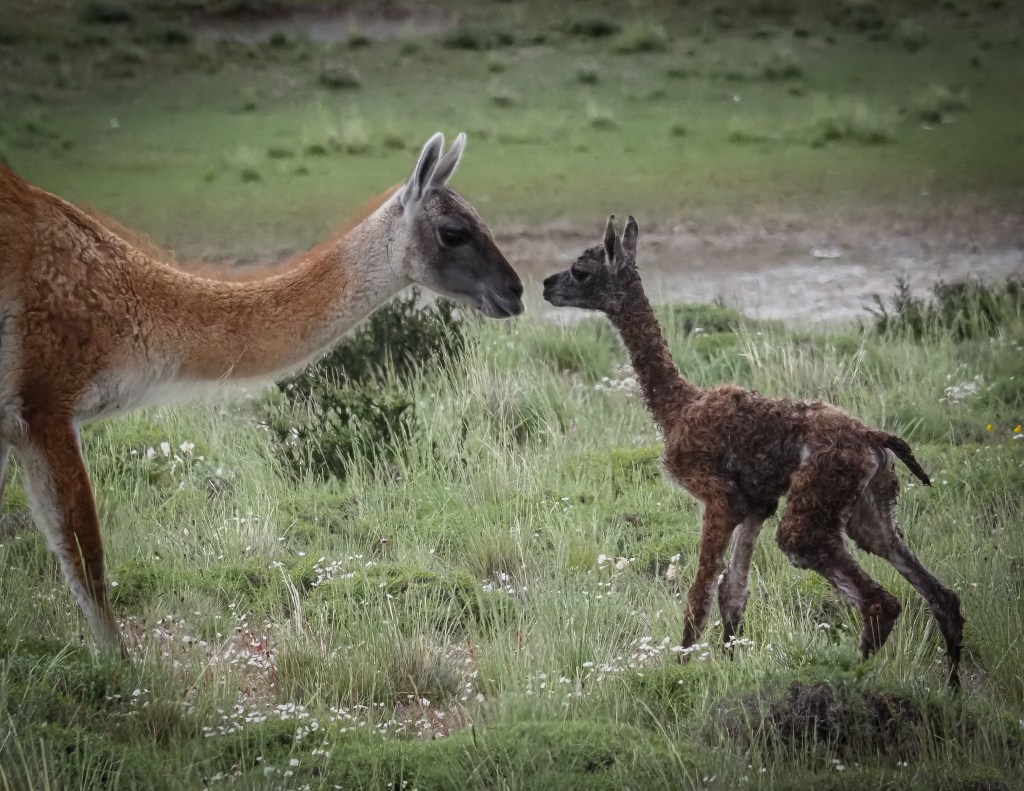
We timed it! From the second this kid impacted Terra Firma (with its face!) to the time it stood alone on four very wobbly legs was 18 minutes and 28 seconds. It took the little one about another 12 minutes to locate mom’s mobile milk bar, and after that, on a hopefully sated stomach, running was next and seemed to come naturally!
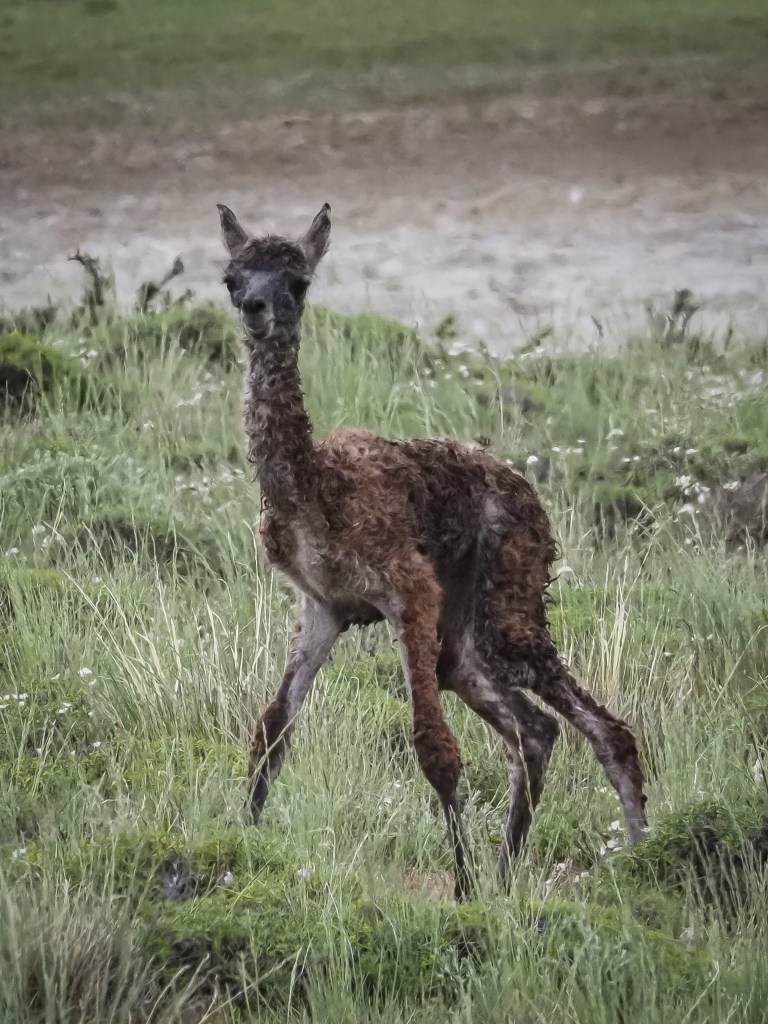
With a mortality rate of about 90% in this area due to predation, hopefully it survives to see winter!
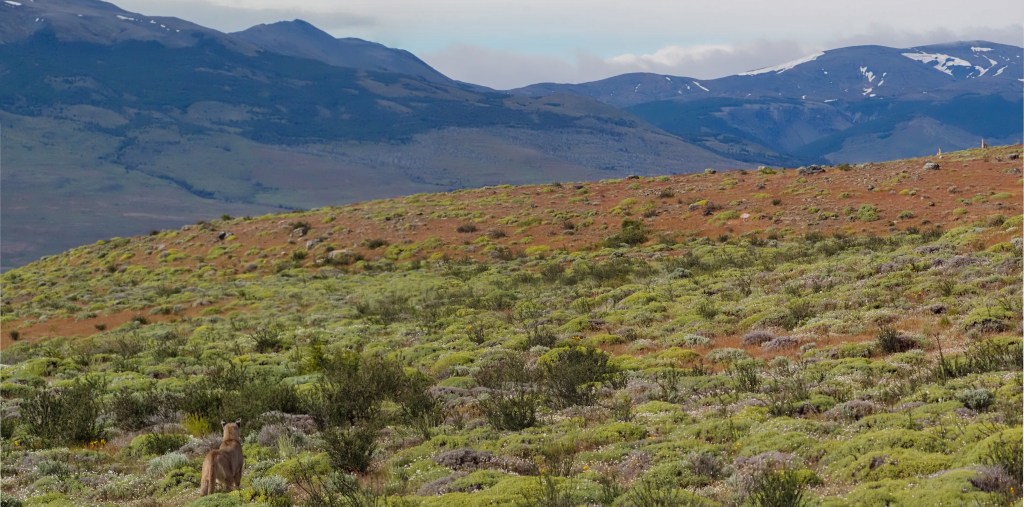
So this is a Puma and normally about as close as you come. I am using a 100mm-400mm OM-Systems lens. This Puma is about a foal distance of 100 mm so that you can almost see the two Guanaco heads looking at the Puma from over the top of the ridge on the right side of the frame. This the typical hunting scenario for these cats. If the Guanaco see a cat, they immediately start announcing an alert call, more of a screech, to warn every other Guanaco in about a half mile radius. Guanaco alerts are incredibly loud!!
When another Guanaco hears an alert call, they will all start searching for the cat, and if the cat is spotted, the Guanaco will start make it’s own screeching alert. So . . . the easiest way to find a Puma is to wait for a Guanaco alert, then see where all the Guanacos around the cat are looking, and the Guanacos simply triangulate the cat for you!! That is . . . as long as they SEE the Puma . . . which does not always happen!

We watched this Puma and Guanaco interaction from a hill top after following the Puma for about an hour. The cat had been trailing this small herd, just staying far enough in the rear that the wandering Guanaco did not see or smell it to give it away. The Guanaco had wandered out onto the edge of a ravine and seemed to be blocked in, The Puma took up a position behind the rock to the right with the wind swirling around and up the mountain towards us. The Guanaco wanted to skirt back off the edge of the ravine, but the three lead animals started acting very hesitant of walking into what was clearly a choke point leading right by the hidden cat.
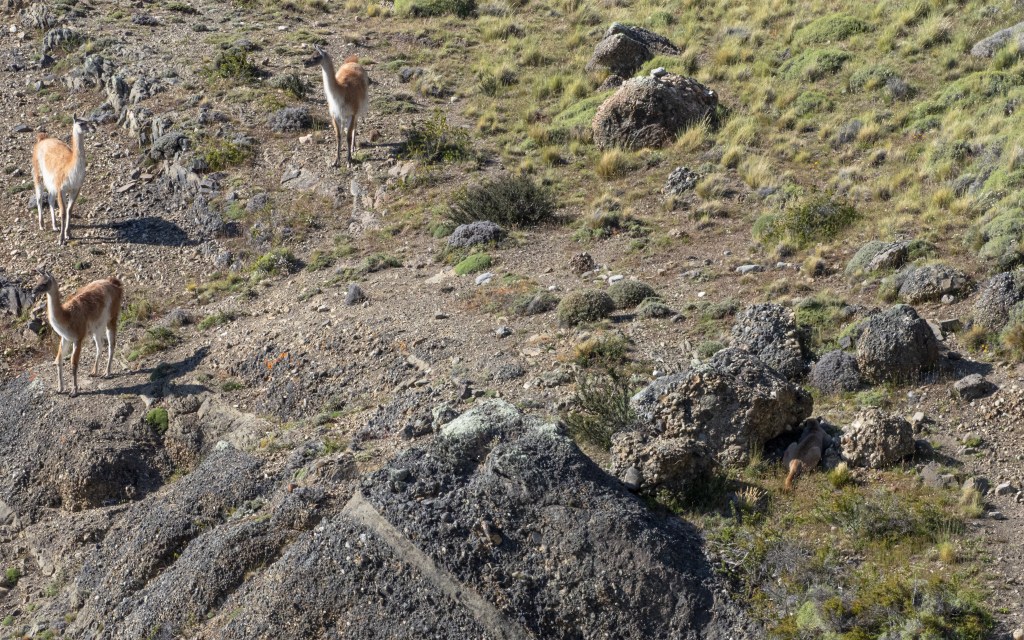
Finally (albeit sadly), the center Guanaco either smelled or caught a glimpse of the Puma and started to alert call. It was close, but once the cat realized he had been seen, the hunt was done. The Puma brazenly stepped out from behind the rock and laid down in the sun and in full view of the Guanaco. The Guanaco lived to tell the tale and the Puma was last seen following the Guanaco over the ridge again . . . and the hunt continues!
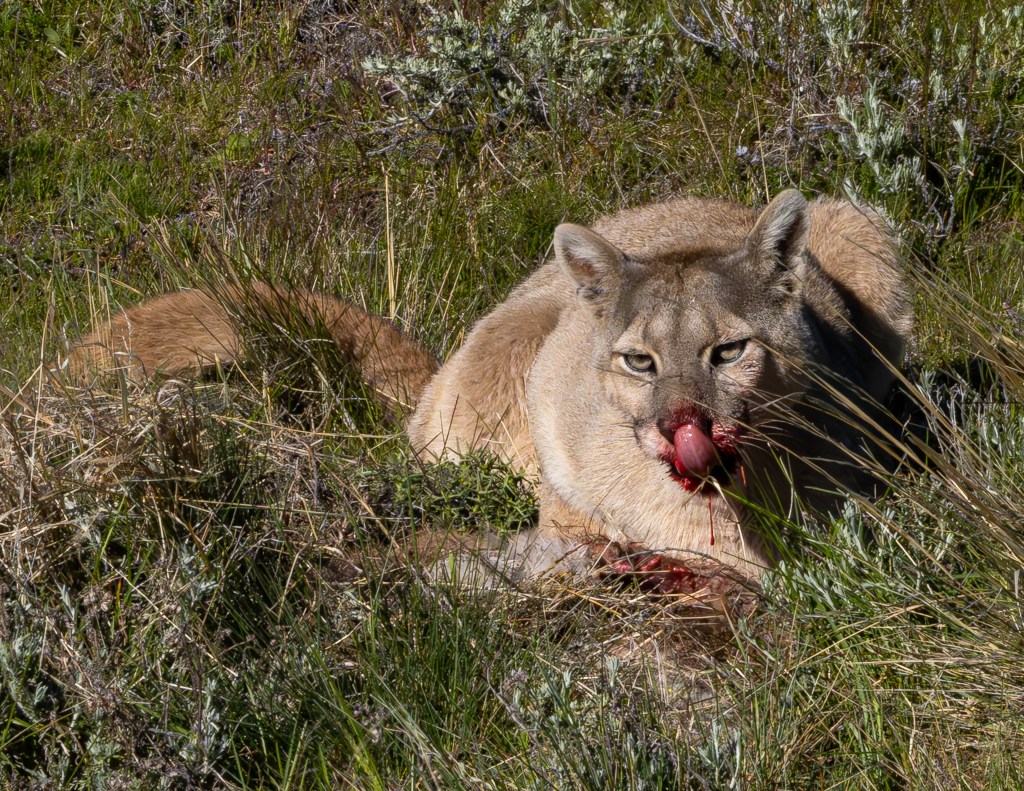
I never did have the chance to see a Puma take down a Guanaco and apparently that is a rare thing to see happen. We did, however, get to see a Puma feasting on a baby Guanaco that it had killed earlier in the morning.
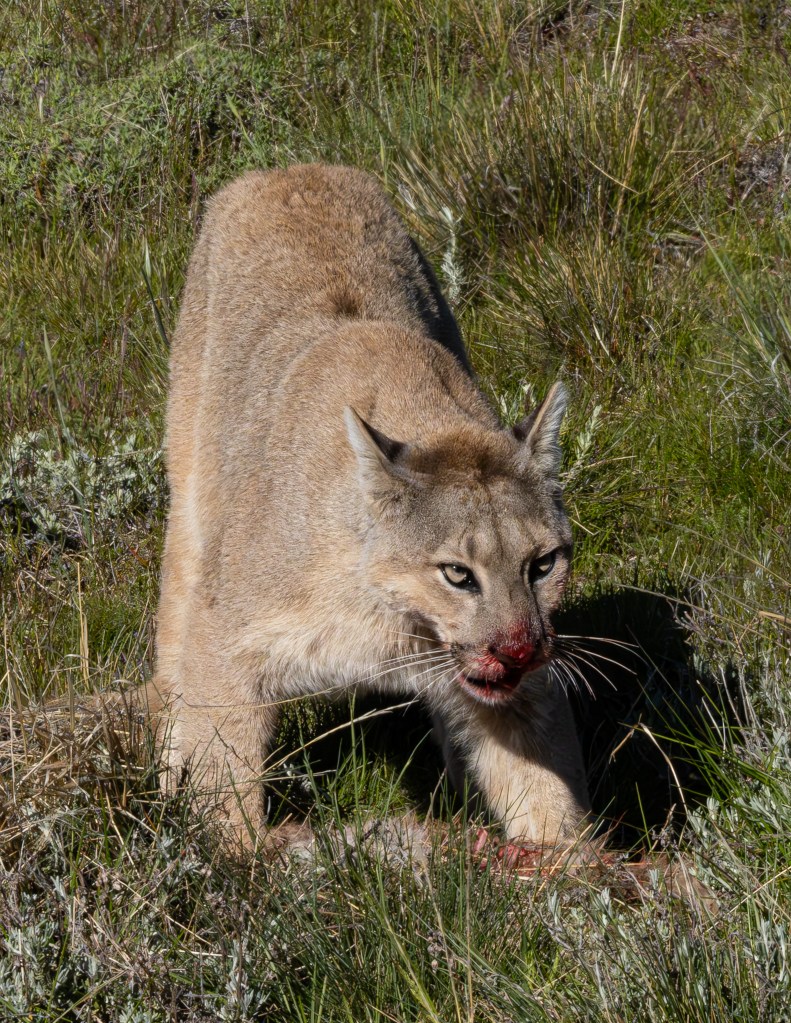
This photo is of a young (2-3 year old) female Puma. For reference, I am about 35 feet from her, sitting on the slope and looking somewhat down on her. She, like most of the Puma on the estancia and in the Park are habituated to humans. As long as we keep our distance to what she feels is comfortable, she has no fear of us. Yet, as soon as one of us inched closer, she would spin around, make eye contact and then abruptly turn her back on the offender and let them only see her back side. Thus, if you got to close you then had to get up and reposition around her if you wanted to see her face (and you also caused everyone else to need to move as well!)
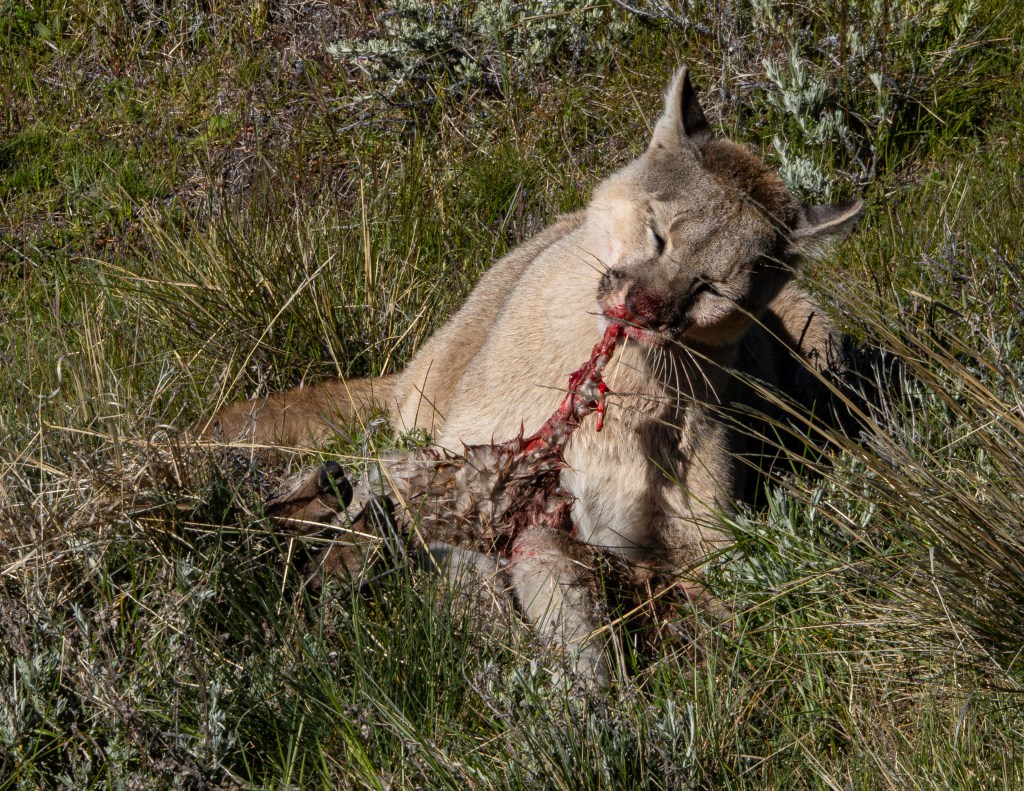
We were close enough that we could hear the carcass being stretched and torn as the Puma ate. Not really pleasant sounds and something that will always be remembered.
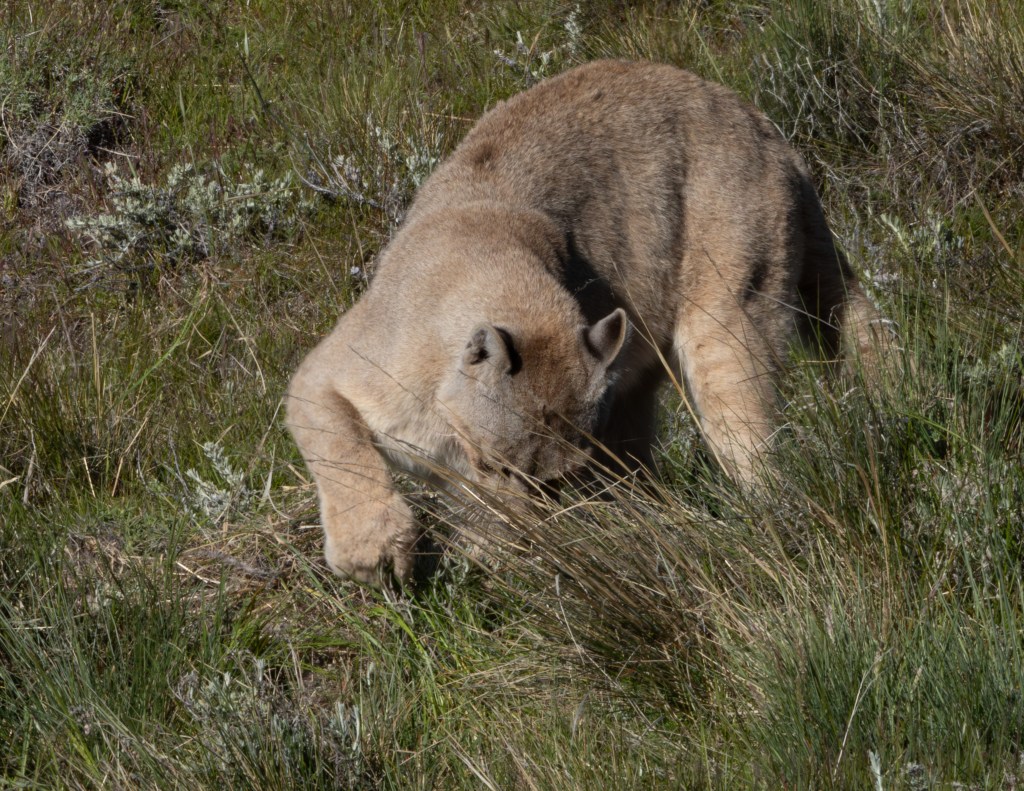
Here is a typical cat behavior . . . with the carcass only partially devoured, the Puma hides the remainder from other predators by covering it with grass. The meat does not spoil quickly because of the ambient temperature and the cat may come back for days to gnaw on what it left!
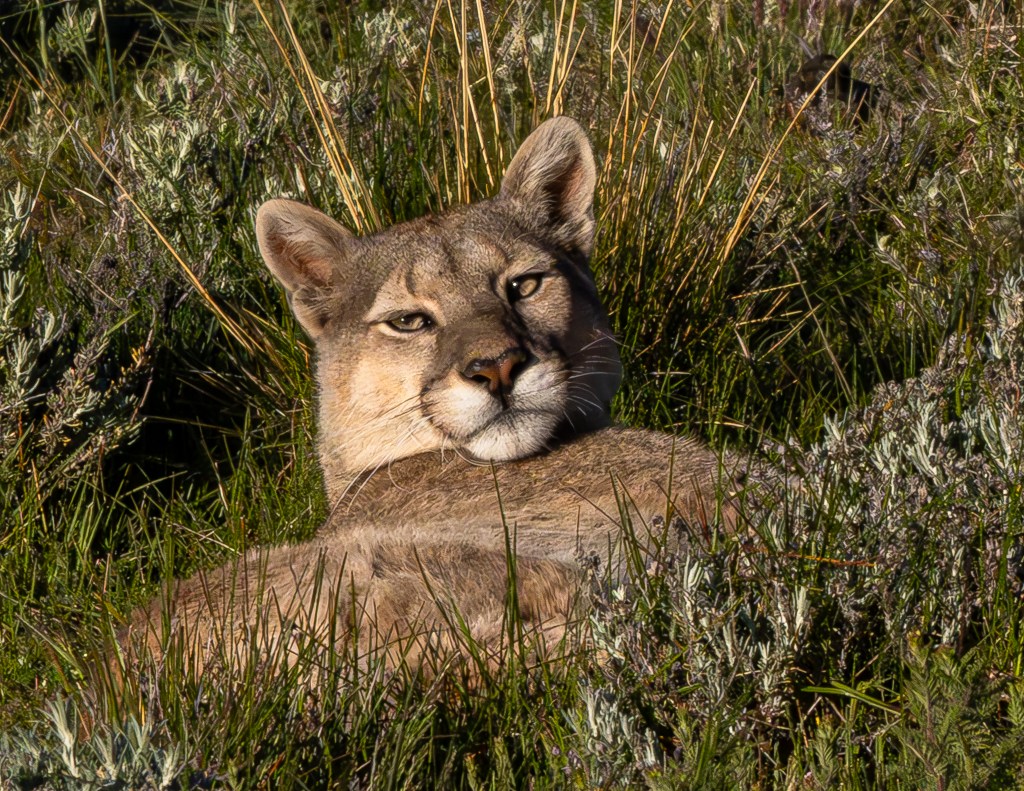
When the Puma is done eating, it is time for a good tongue cleaning of all furry parts and then a quick nap in the sun.
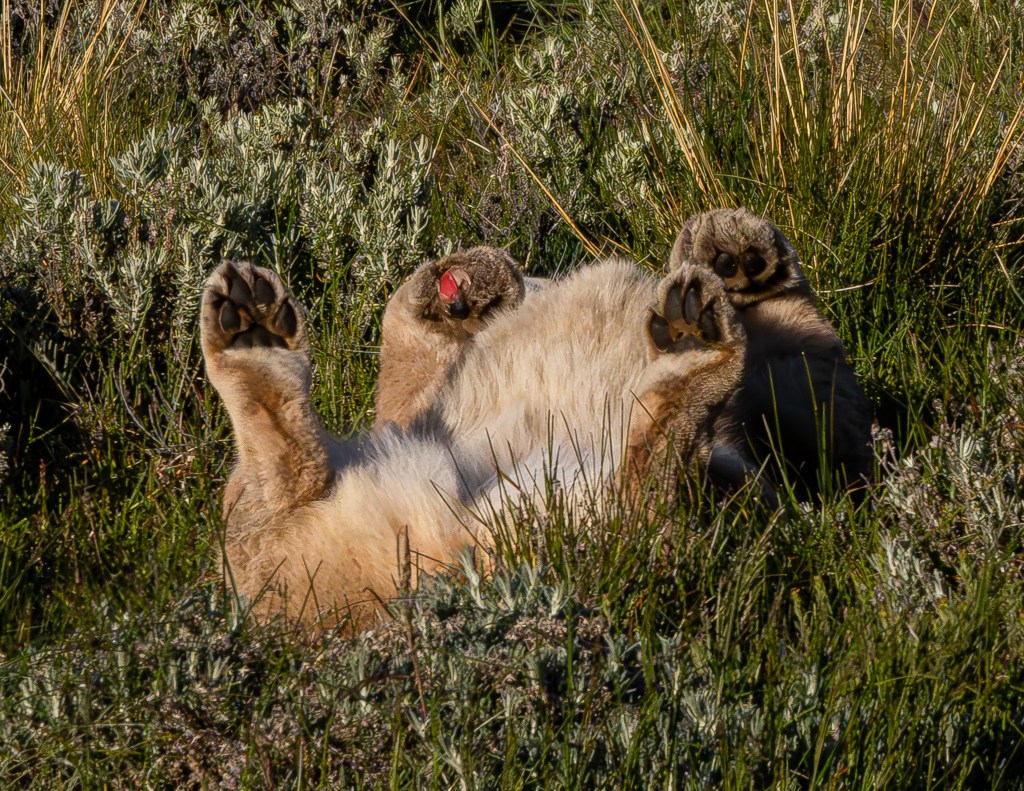
But even an apex predator like her does not always come away from a hunt without damage. You can see in this photo, as the Puma relaxes and warms up in the sun, that she has torn the side of one of her claws badly. She spent an extra amount of time licking it clean and now she is letting it dry.
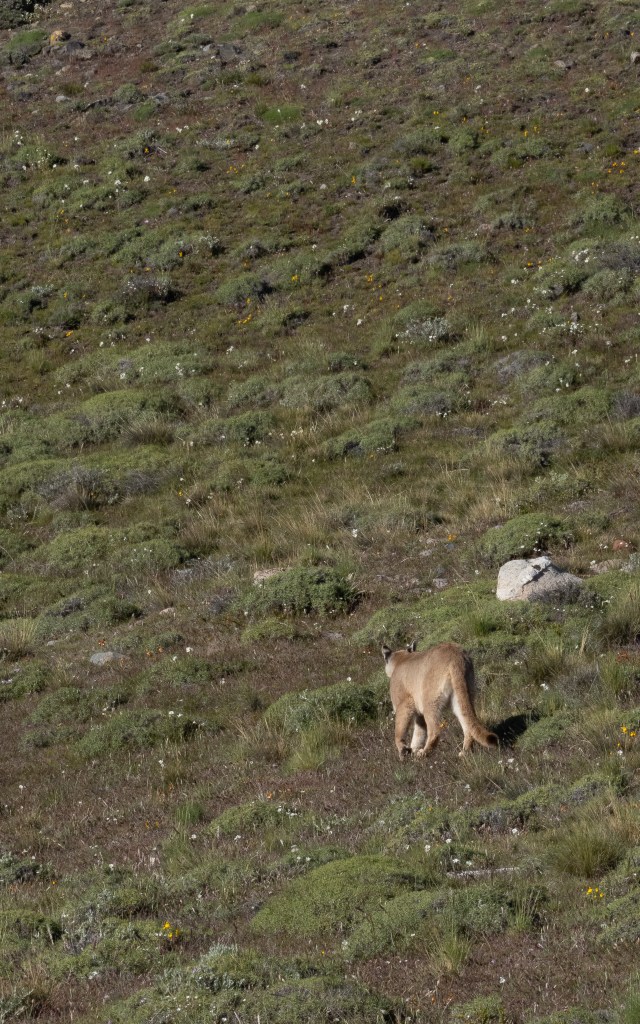
Off she goes . . . looking for water . . . maybe looking for a new kill . . . and we start again on our “walk with Pumas”.

A different Puma this time. This is believed to be a young male but we never saw his junk so we never confirmed the gender. He was not as accepting of us watching him on his kill so we left him alone!
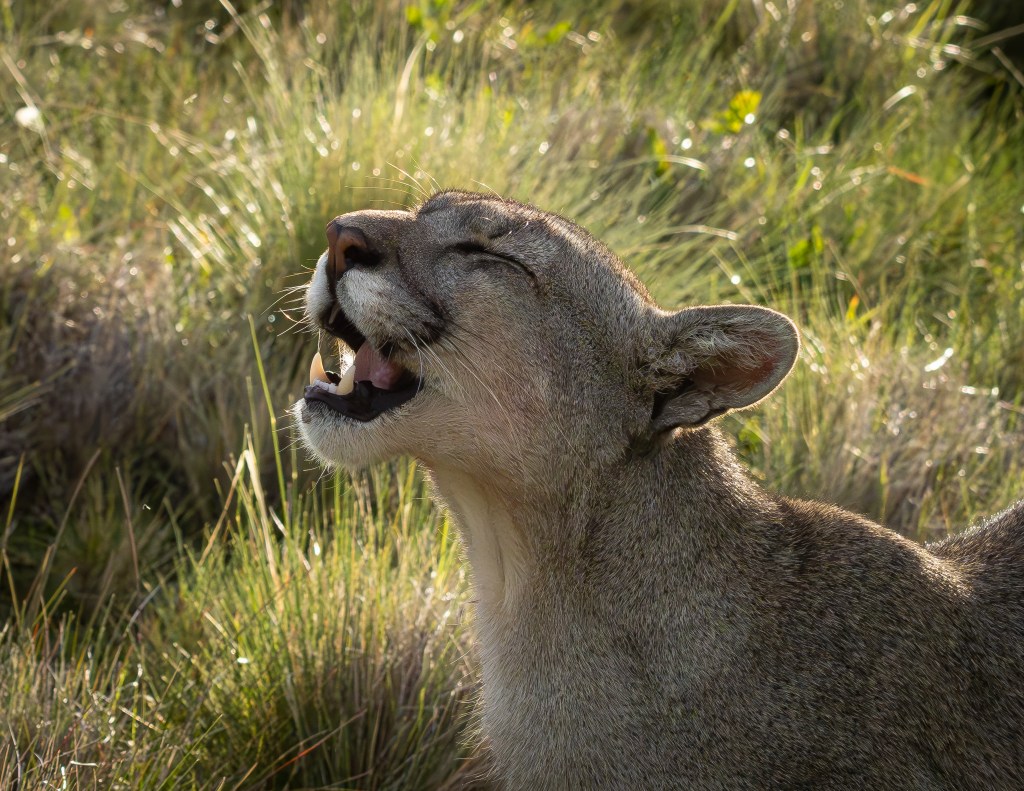
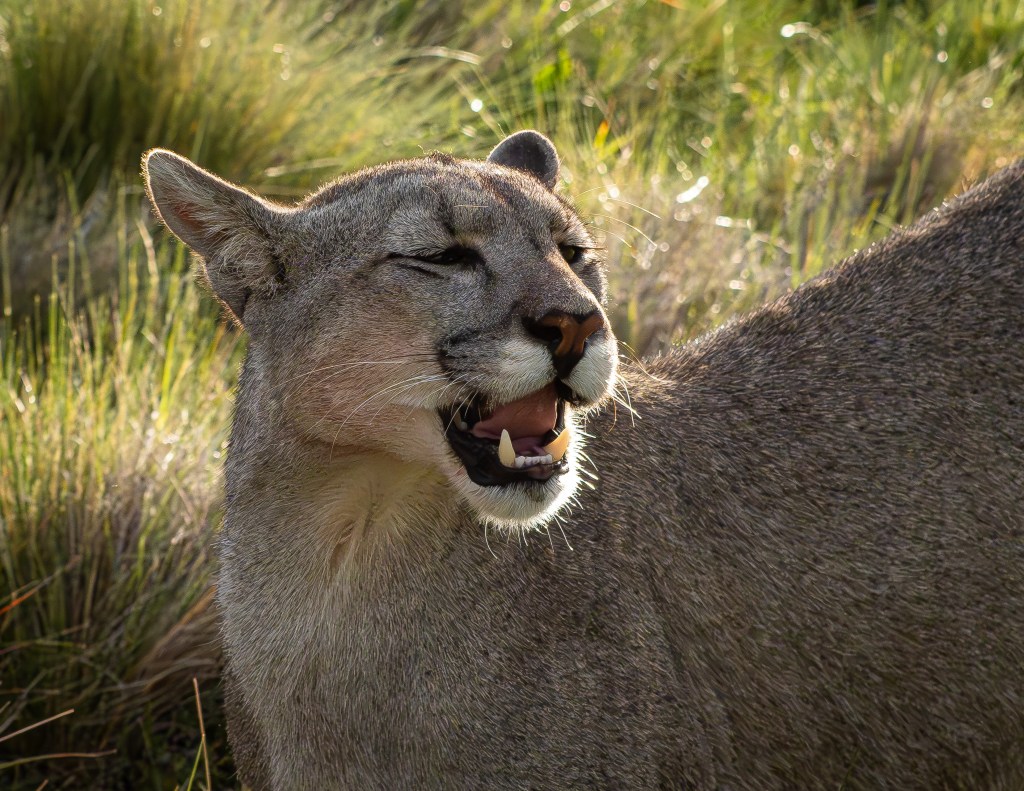

In the previous three photos, I would like you to meet “Amarga”! She is a 2 1/2 year old female Puma and is the daughter of a Puma known as “Pataka”. If you watched the NETFLIX series call “Predators” and saw the segment on Pumas in Chile, you saw Pataka when she was a cub. The trackers and outfitters that work in the Park and on the estancias have documented the lineages of many of the cats going back 15 to 20 years, and most know the individual cats on sight by name.
We came up on Amarga as she was walking away from a kill that a young male Puma had let her share feasting on earlier. We were on one side of a narrow valley with Amarga on the other. We were staying in front of her as she cam down the valley so we could get some great portrait shots.
Little did we realize that the valley was narrowing rather rapidly and we had positioned ourselves at the bottom where Amarga would need to cross. We stopped and allowed her to swing by and get in front of us, believing that she would walk around and up out of the now ravine. But cats do as cats want and that was not her plan.
I was in the lead position and crouched low so I could get shots from her eye level, which at the time seemed like a good idea and that afford me some very unique shots. In a heart beat, Amarga back tracked and was walking right towards us, and not slowing down. The outfitter quietly said “NO ONE MOVE” . . . I couldn’t and the Puma was too close to even focus on, so I lowered my camera and just watched her approach. She stopped in front of me, sniffed and huffed, looked me in the eye, and just as fast . . . stepped away and was gone into the grass!
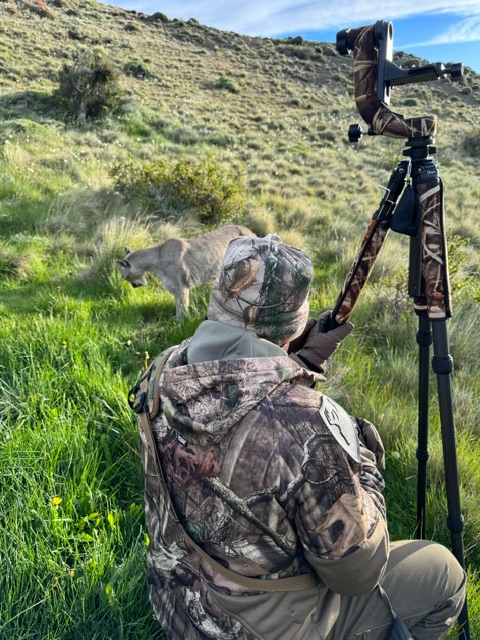
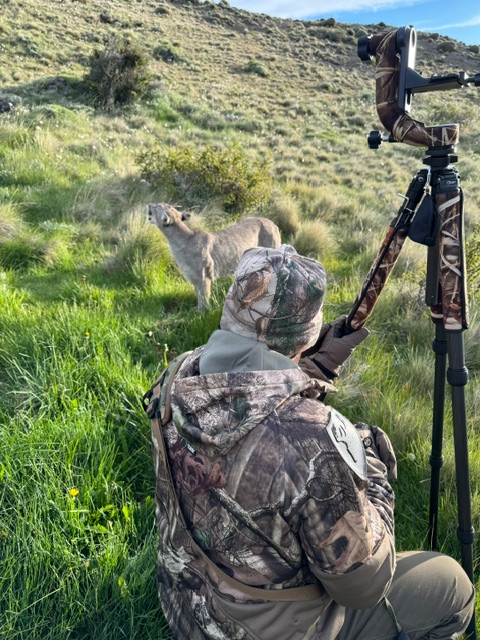
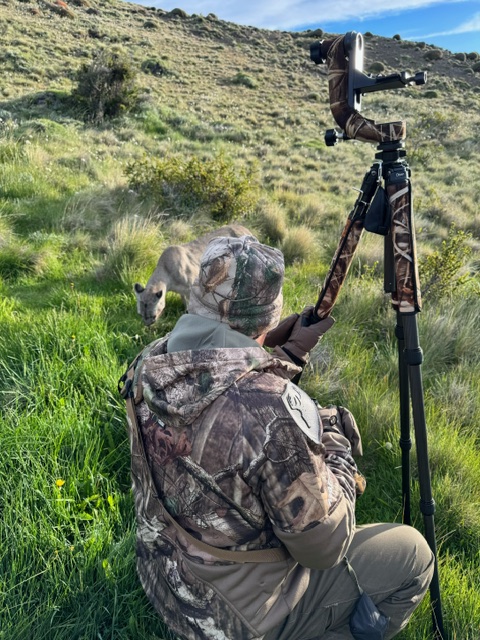
My fellow photographer, who was standing behind me, took these previous photos of me and Amarga. I will NEVER forget those moments and my lack of fear. You would think I would have been panicked, but honestly . . . it was way past panic time and all I could do was simply wait and be in the moment!
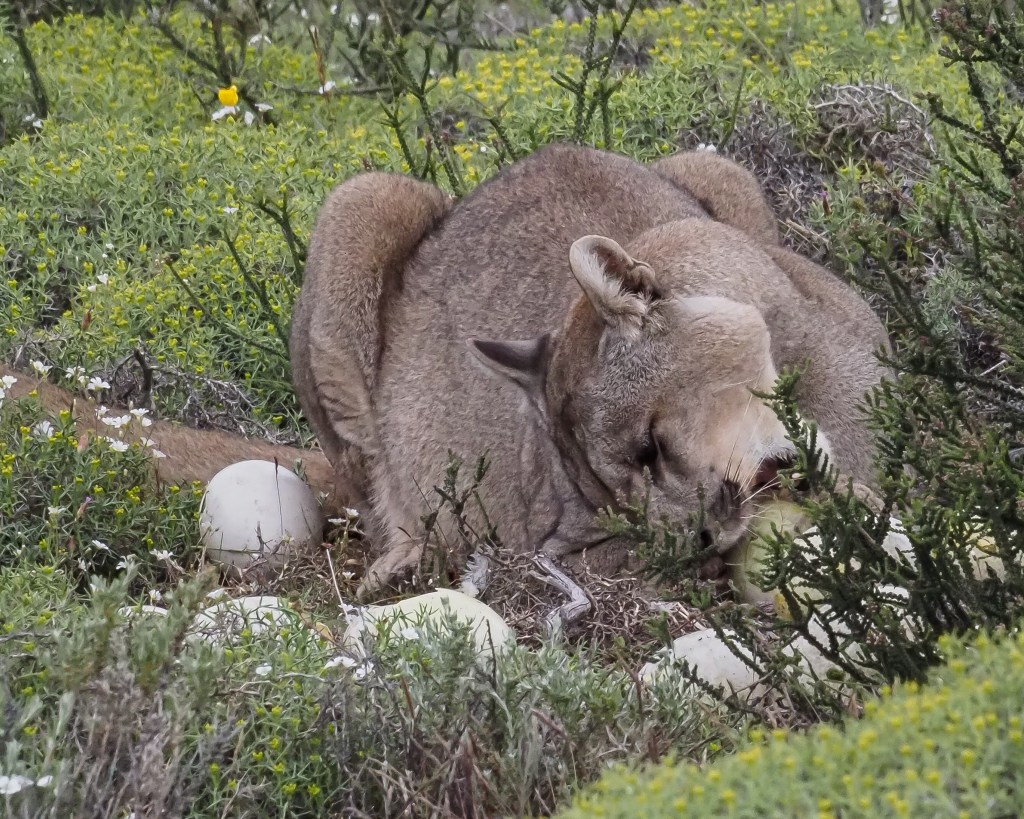
We picked up Pataka one morning. She is a five – six year old female and one of the more habituated Pumas. We walked with her for a couple of miles, when she suddenly seemed drawn to a clump of shrubbery and low grass. At the time, we were too far away to see what she was doing, thinking she had maybe returned to feast on a previous kill. Lo and behold, we were out in left field. Pataka had discovered an abandoned Rhea nest. A rhea is a flightless bird, think smaller version of an ostrich. As we surrounded her with tripods and cameras, all trying to get the best shot through the weeds, grasses and bushes, Pataka proceeded to lay waste to the nest. When she finally walked off, she had eaten 14 of the original 23 eggs.
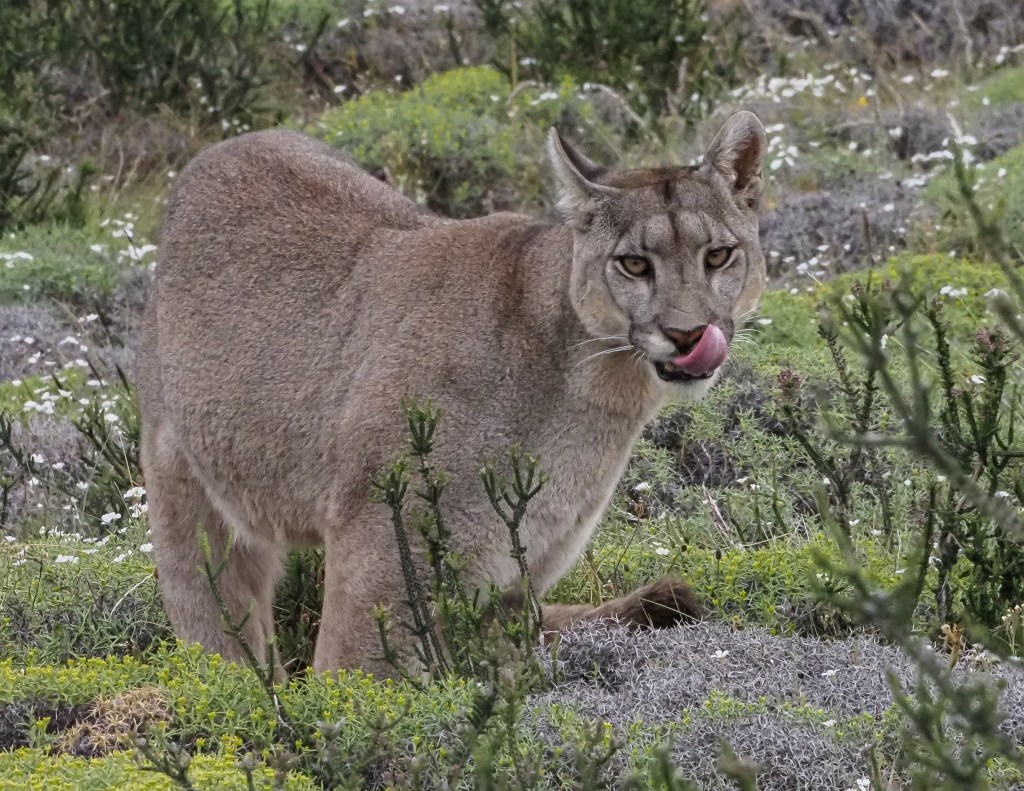
Pataka is easily identified by the scar on the right hand side of her muzzle.
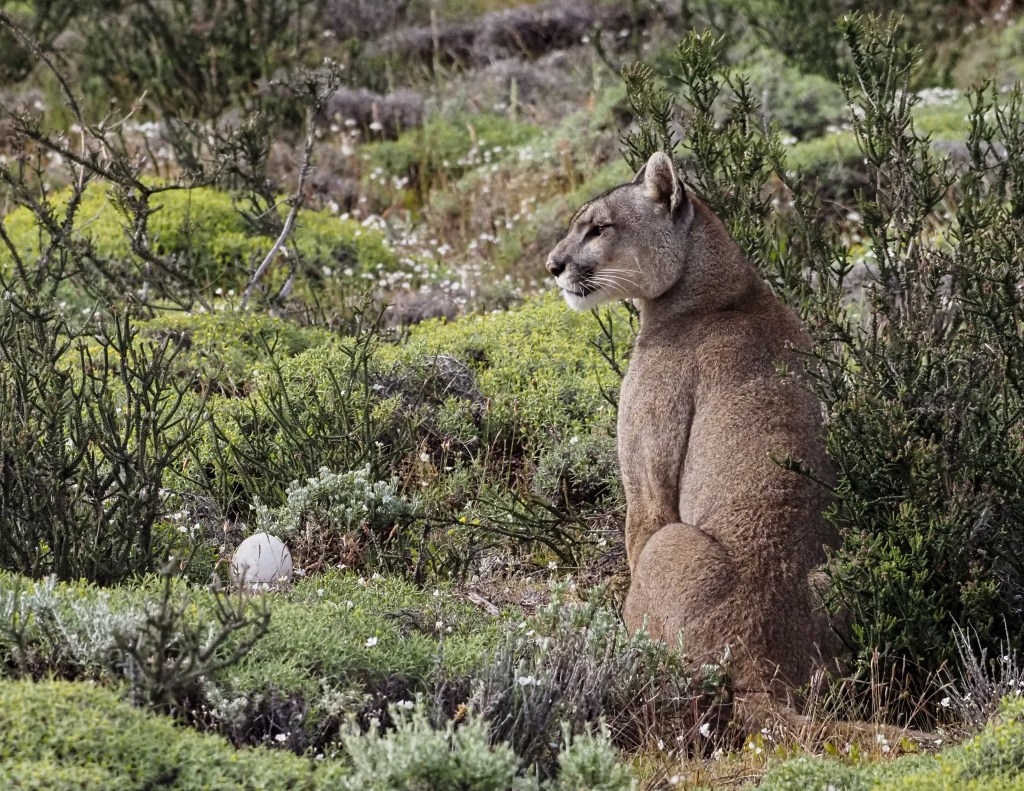
Of all the Pumas we encountered and had the opportunity to photograph, Pataka seemed to be the most disinterested in us and just went about on doing whatever she wanted to do. However, I also know that this is a wild animal, and that if any of us had approached her too close, or possibly interfered with her meal, the results could have and probably would have been much different.
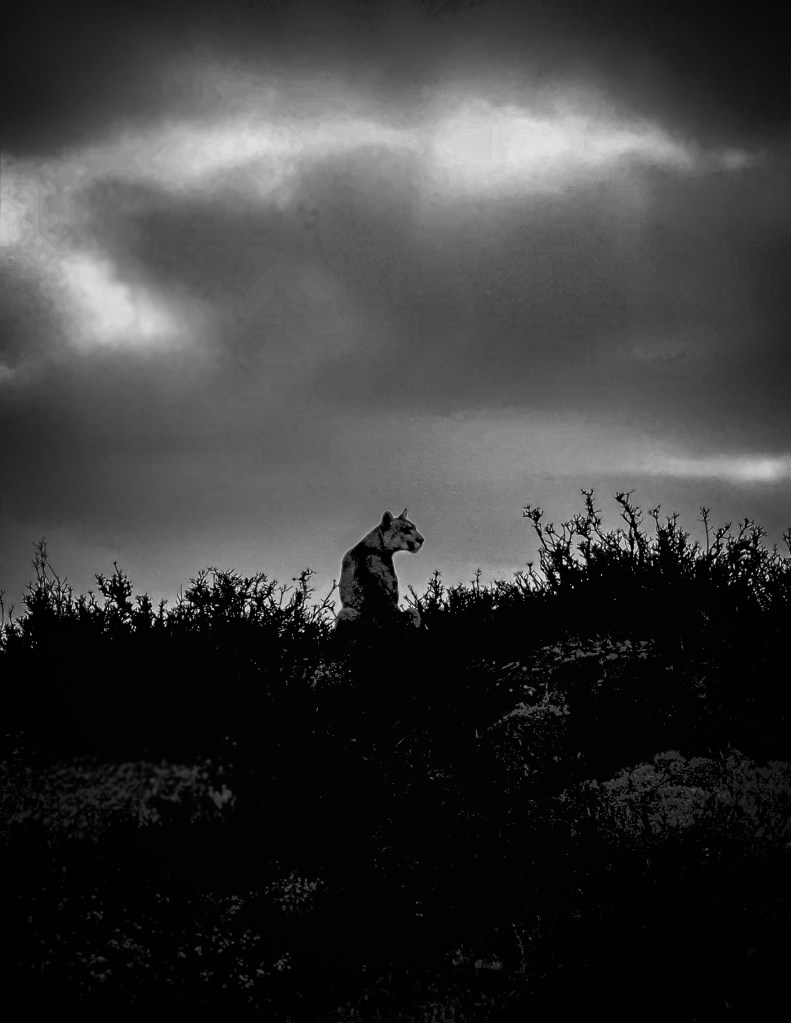
On the last day of following and walking with Pumas, as the weather started to change and we trudged back to the vehicles, Pataka made one final appearance on the ridge line above us . . . as if she was seeing us off to other things.
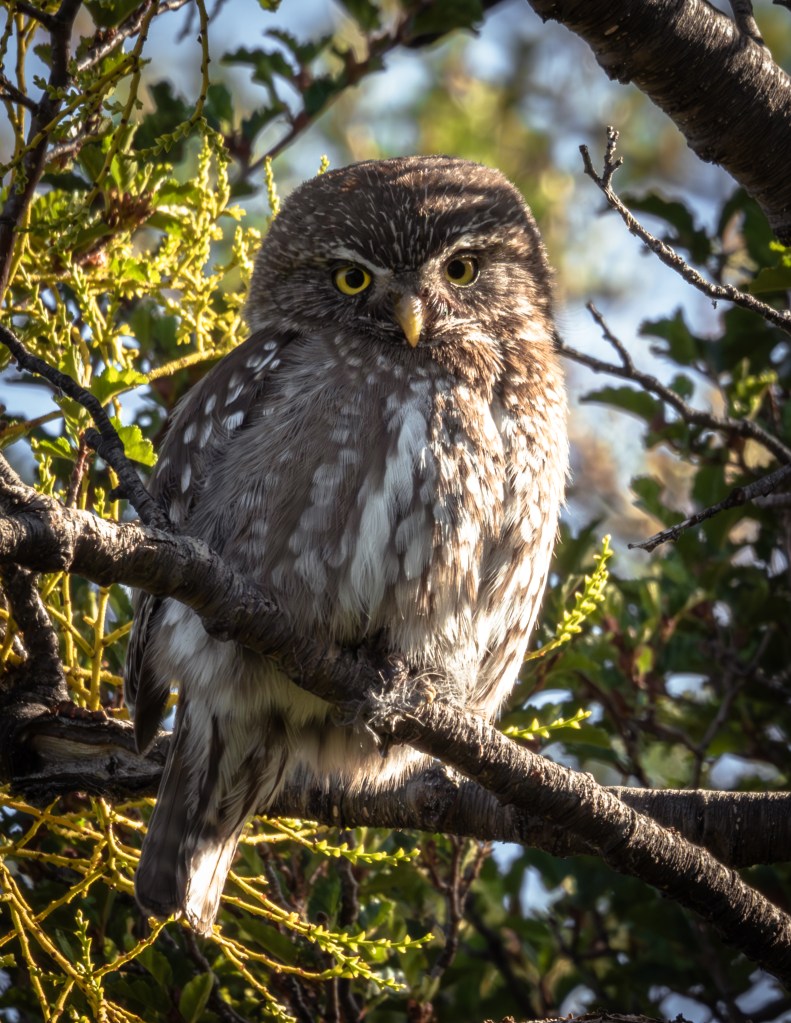
Southern Chile is not all Guanacos and Pumas . . . there are some gorgeous birds, like this Astral Pygmy Owl.
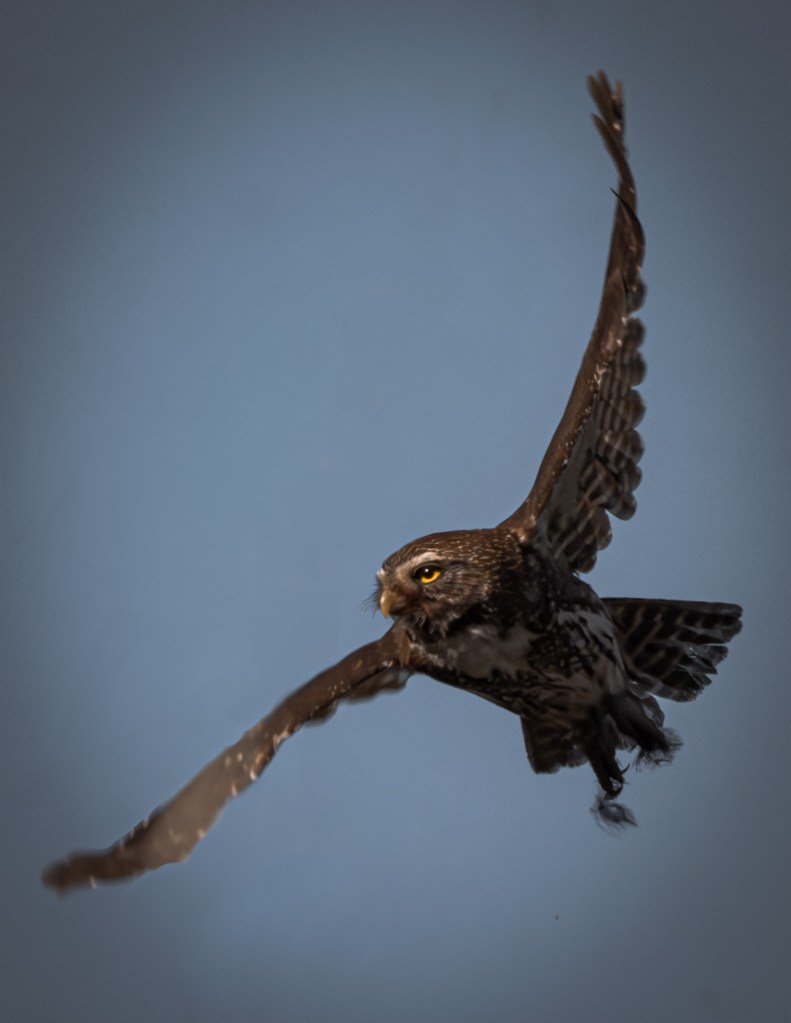
Cutest little Owls and very quick when they are dodging between the trees!
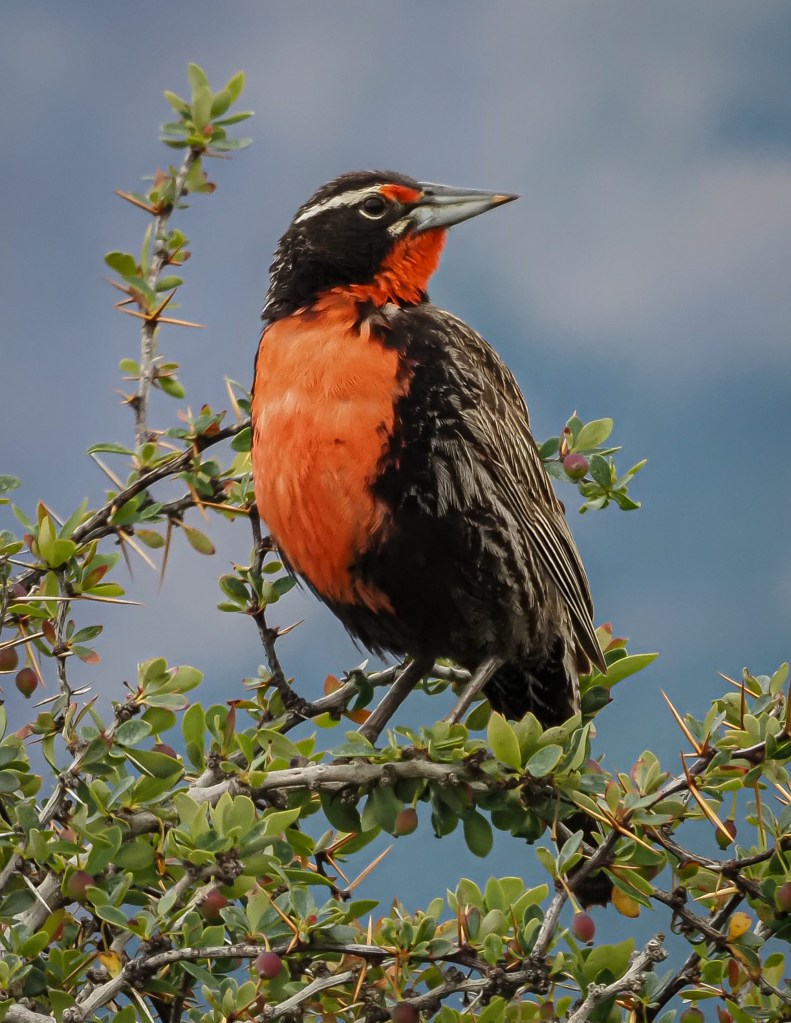
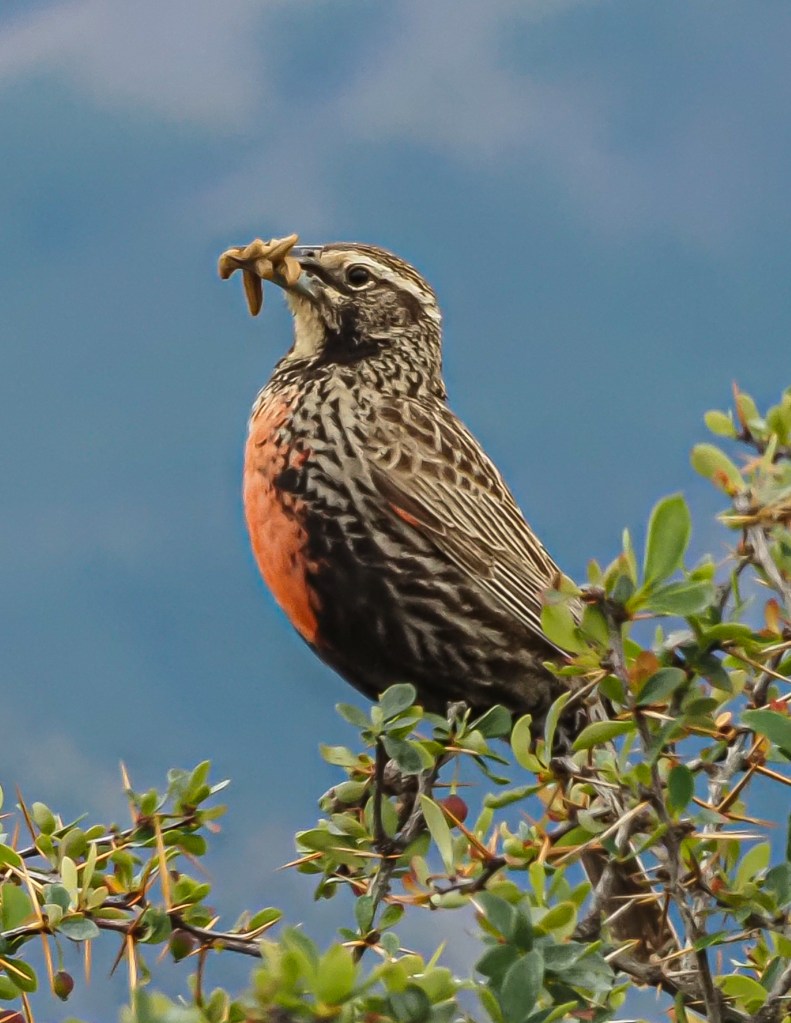
Previous Photos are of a male and a female Astral Meadowlark. They are highly visible by the flashes of their bright orange chests.
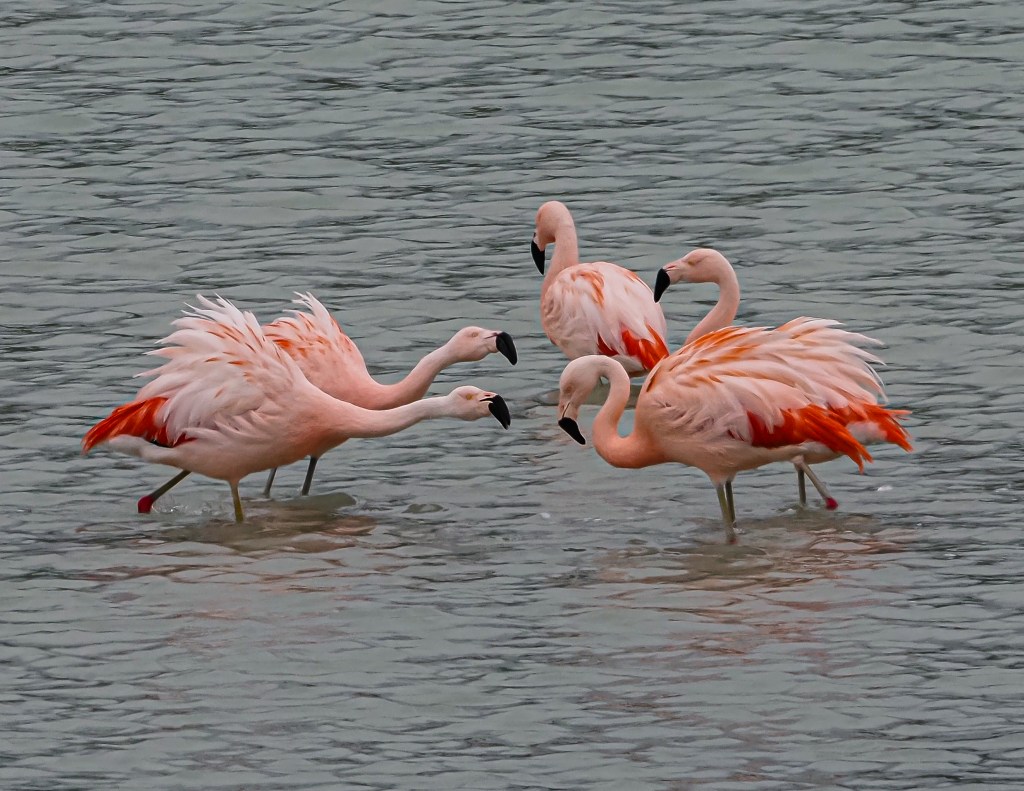
Chilean Flamingos having a small discussion over water rights! I wish I could have seen them closer, but they were on one lake in the park and there is no trail around the lake, so I could not get closer and I did not want to violate the Park rules by going off trail.

On our way from Puenta Arenas to the Park, we stopped for the afternoon at a special estancia that caters to birdwatchers, in particular to those of us who want to see the Andean Condors. The climb up to the edge of the escarpment was not fun. The winds were howling with gusts at about 50 MPH, actually worsening as the day went on! Yet, the condors seemed to love the wind!
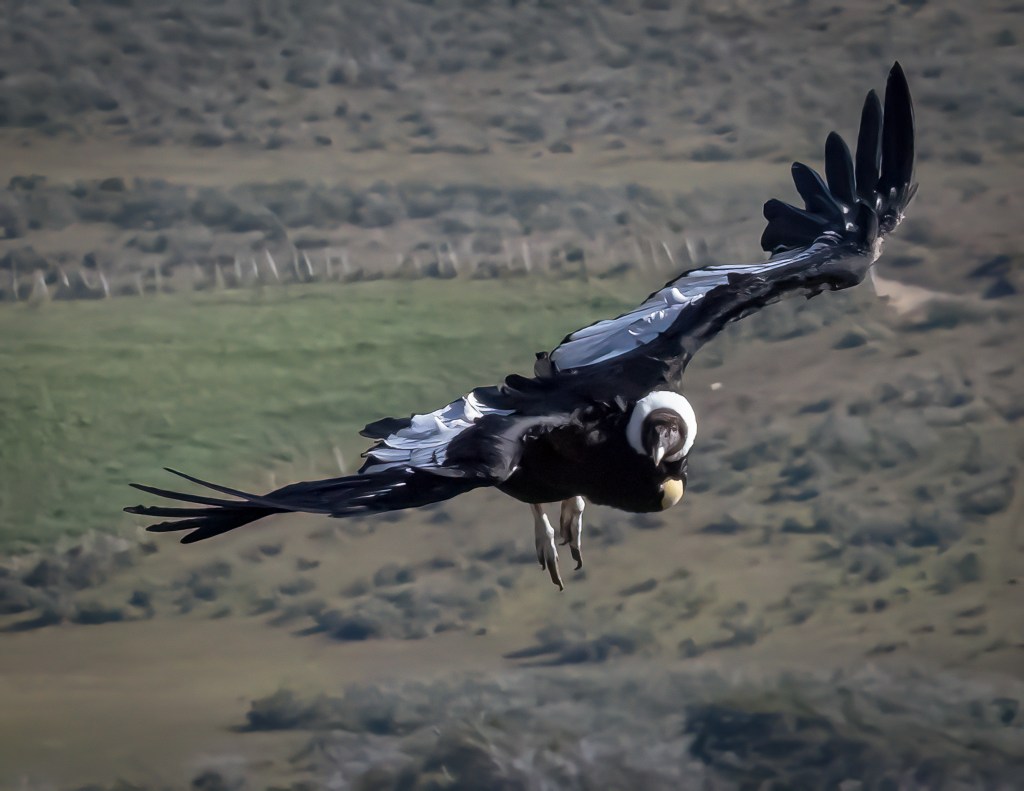
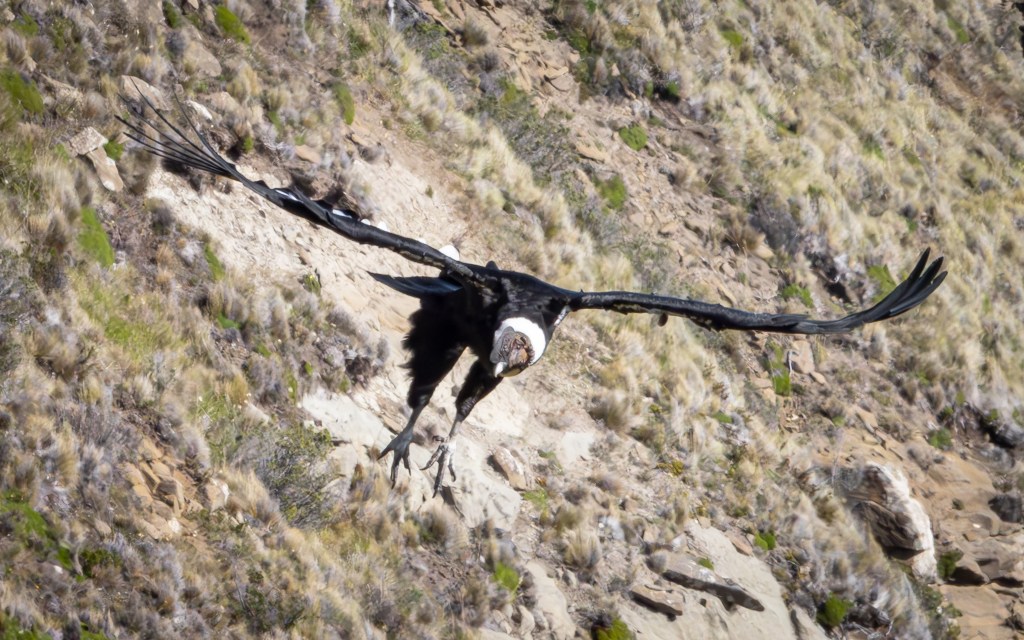
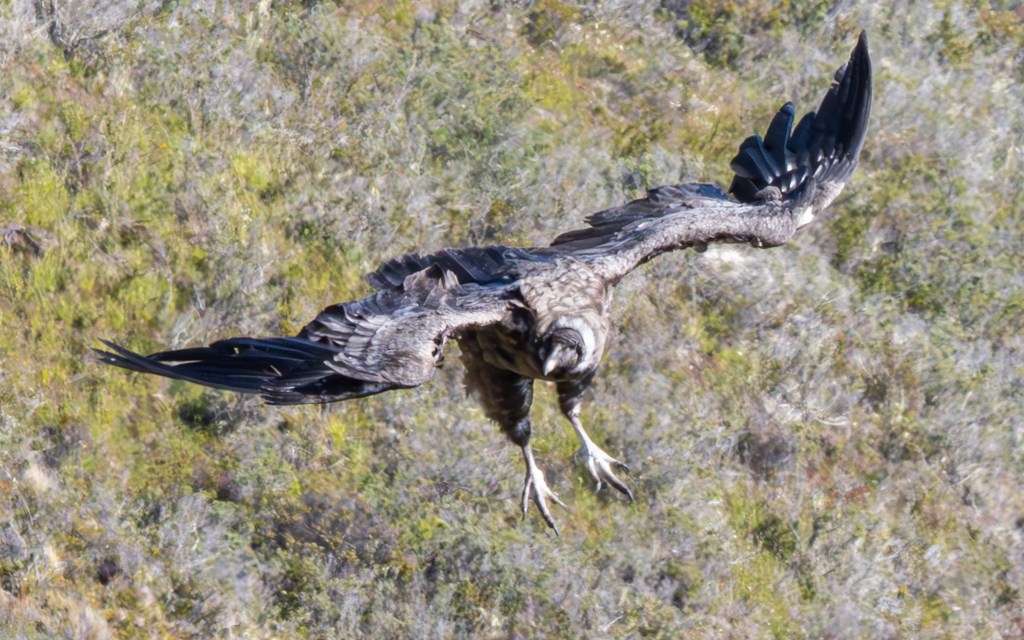
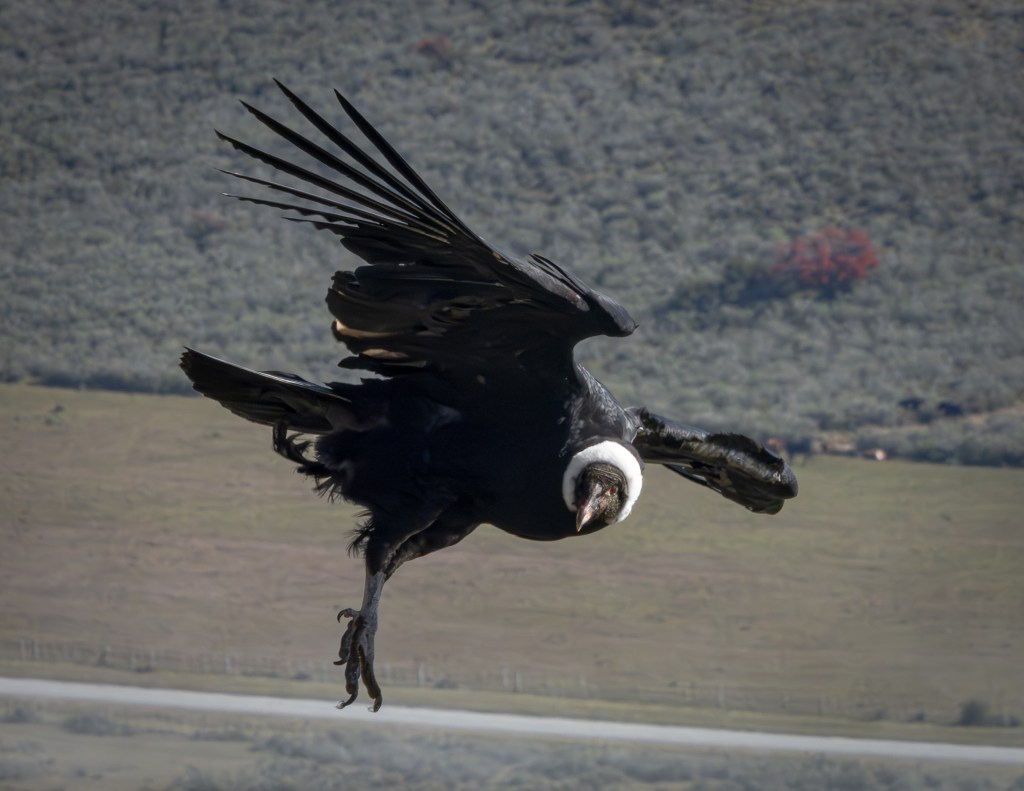
These birds are huge!! They weigh between 20 – 25 pounds and have an 11 foot wingspan. In the picture above you can also see that they have red eyes . . .which is a bit creepy! They would make long and slow left to right passes along the cliff edge where we were perched, looking over their shoulders and seeming to be as curious as us as we were of them.
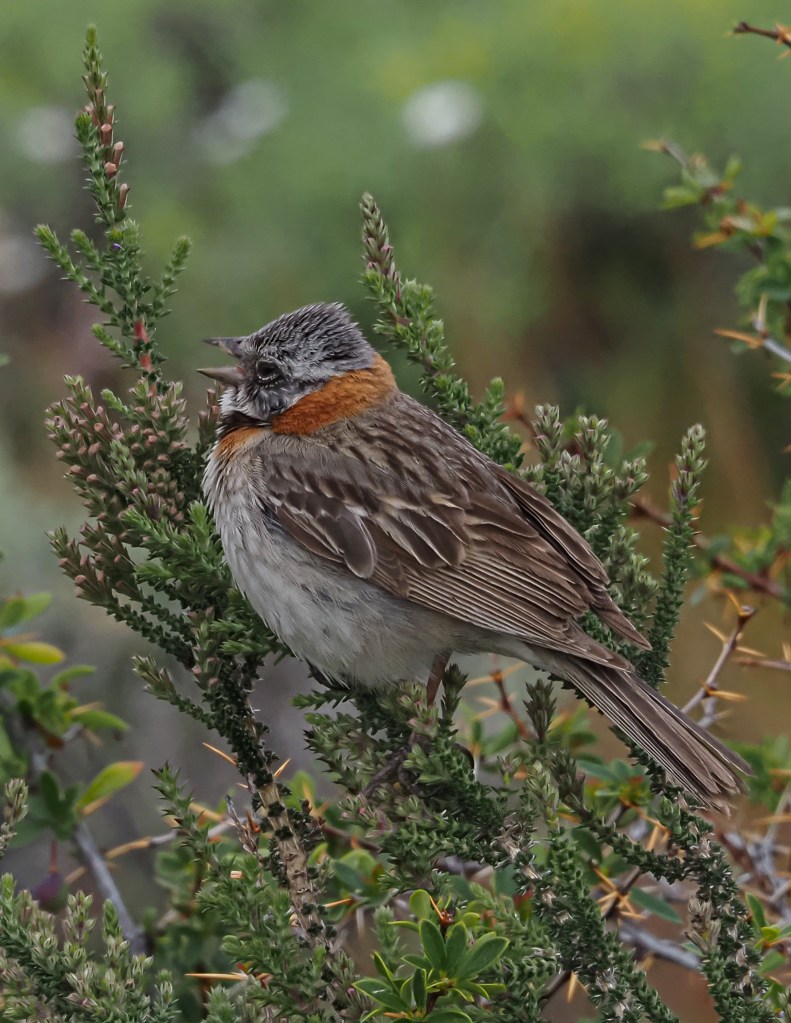
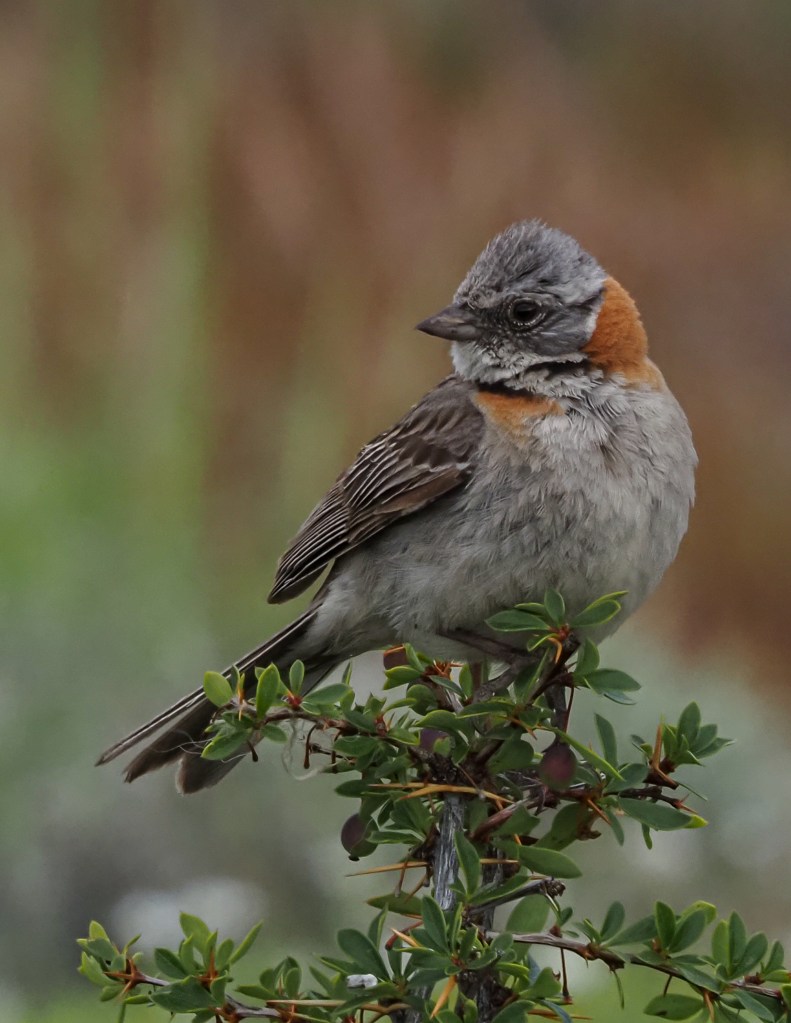
Previous two photos are of Rufous-collared Sparrow. This is one of Chile’s commonest birds.
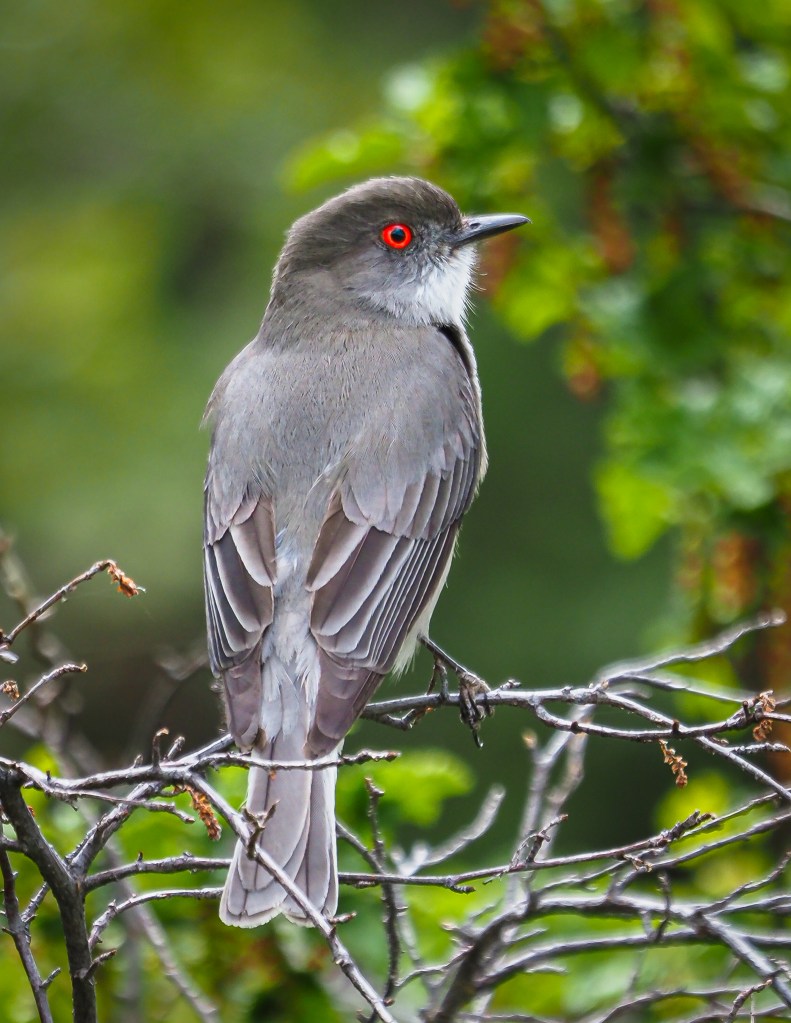
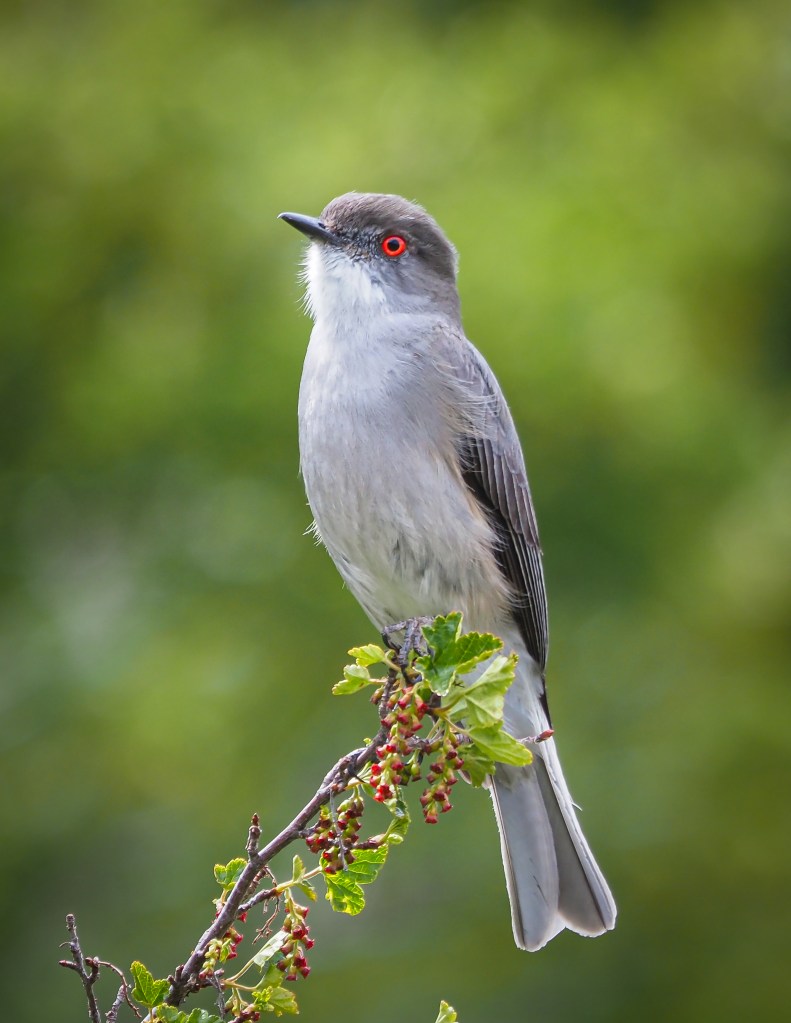
Rightfully named Fire-eyed Diucon, a subspecies of the family of Tyrant Flycatchers.
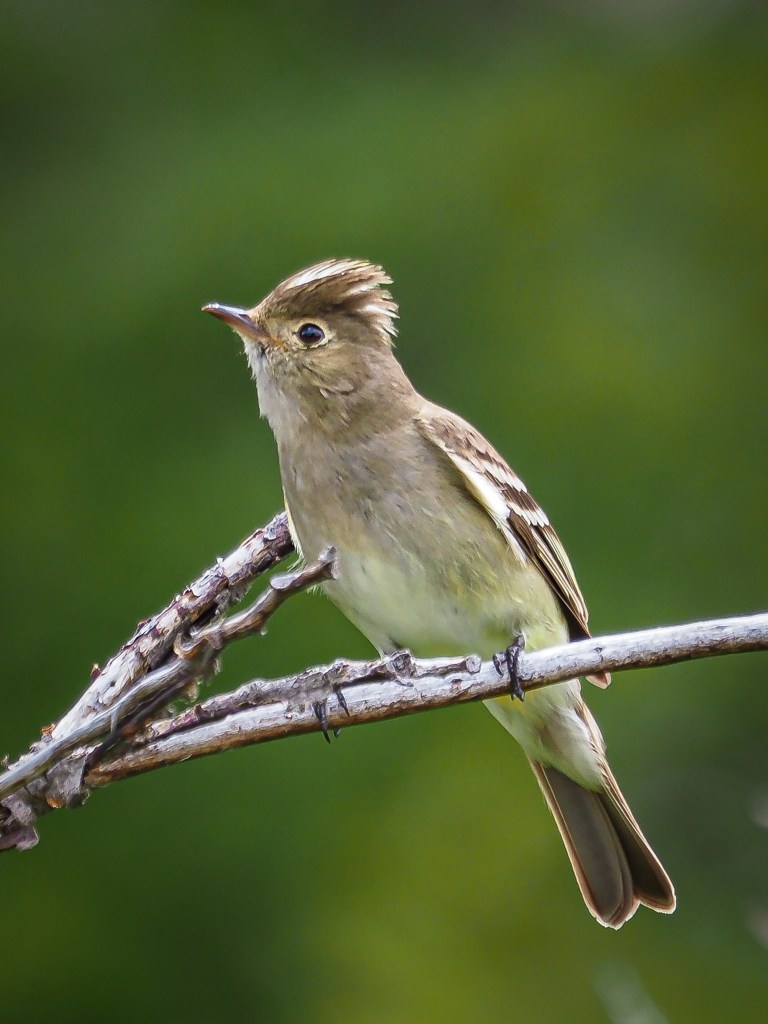
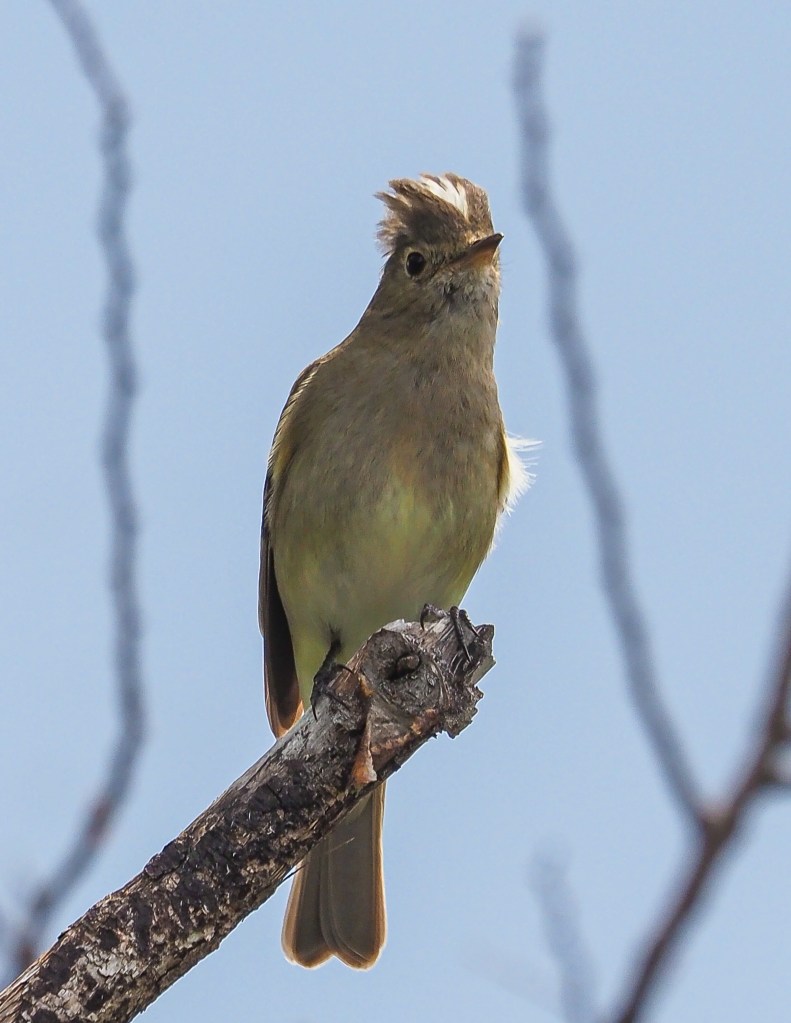
A White-crested Elaenia, a subspecies of the family of Tyrant Flycatchers.
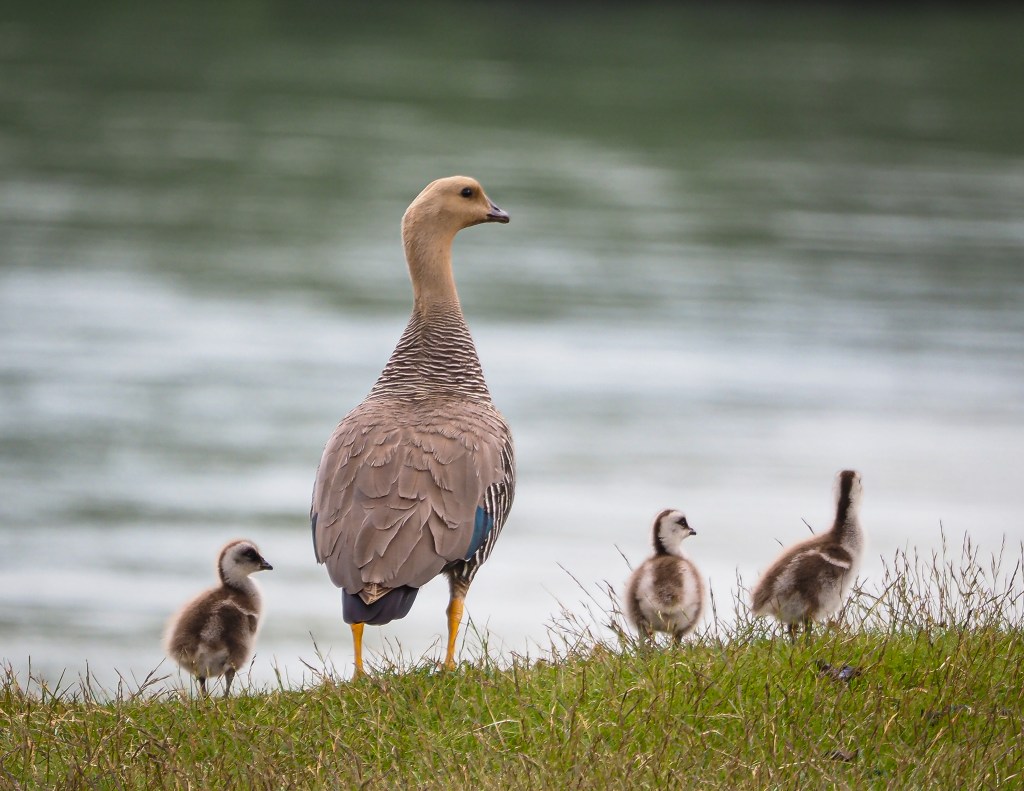
Female Upland Goose (or Magellan Goose) with Gooslings.
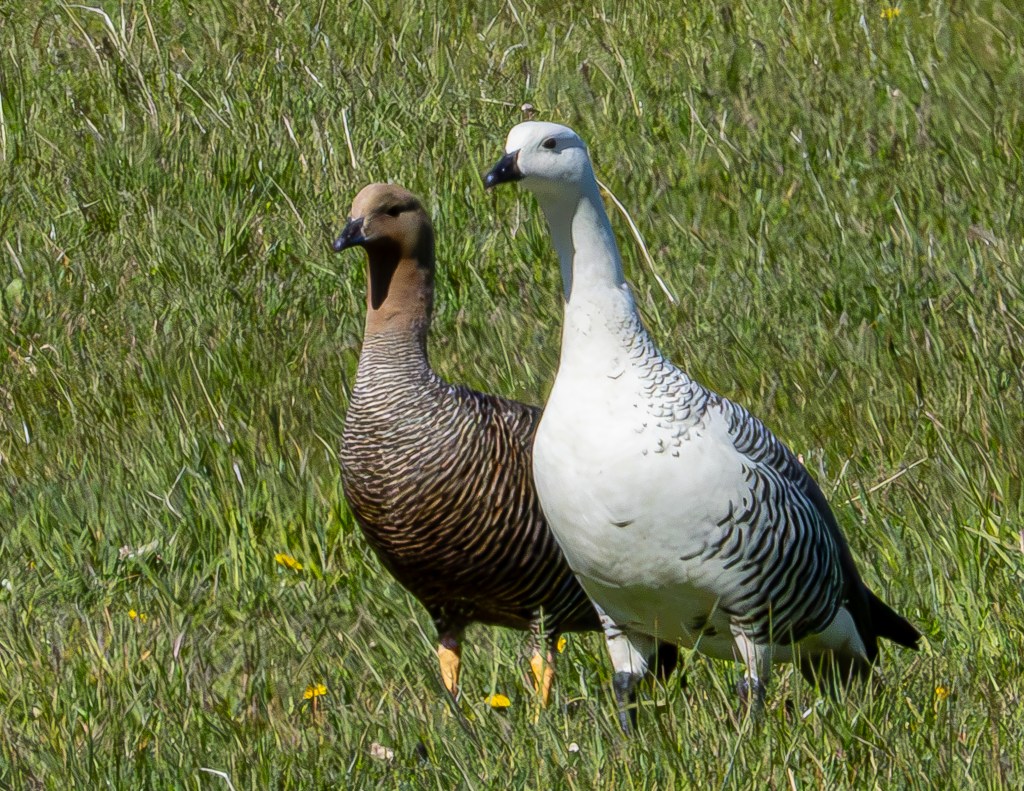
Mated Pair of Upland Geese (or Magellan Geese). These birds are very common throughout Patagonia.
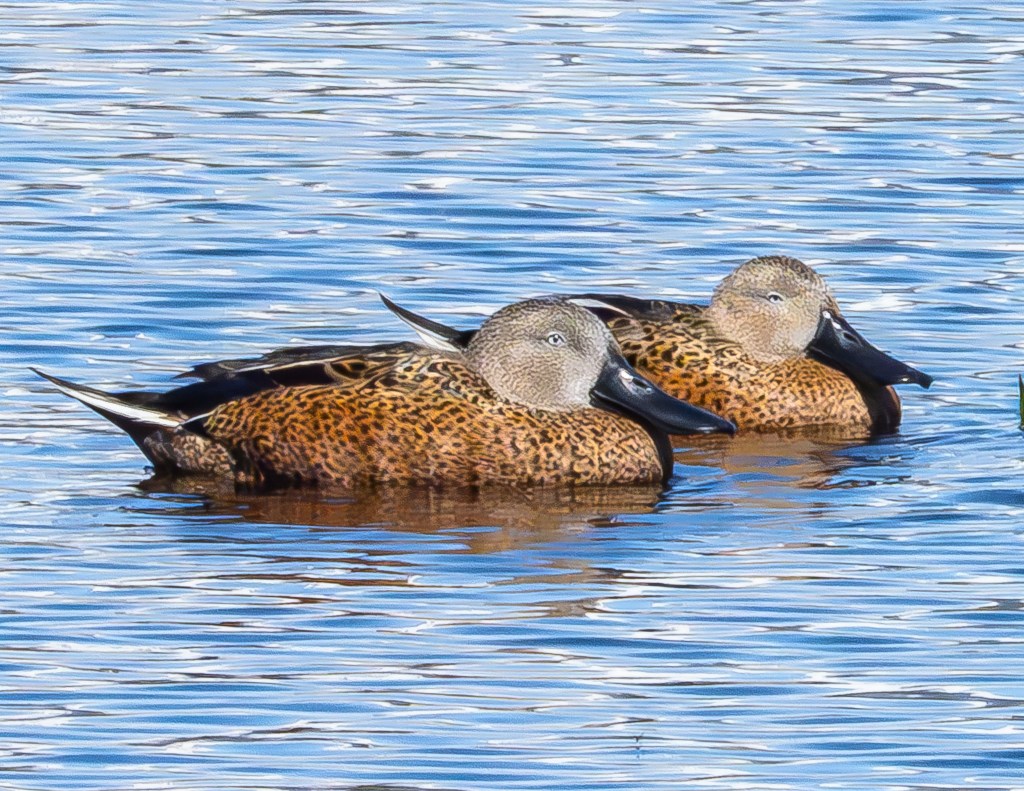
These are Red Shovelers, a type of dabbling duck and native to all South America.
So there you have it . . . this was my big trip for 2023. I have many more photos of the Pumas, many, many more photos! LOL I am planning on doing a presentation on the Pumas of Torres Del Paine with the regional membership of the Carolina Nature Photographers association in February if I can get onto their schedule. I conducted a presentation earlier this year on the Jaguars of the Pantanal and it seemed to have been a success. Only time will tell I guess!!
Tomorrow I will, be working on a “Best of 2023 in Photography” to wrap up what I did of value this year. I am working on a plan of where I want to go and what I want to see . . . call it my Wish List for 2024 . . . I am hoping to stay Stateside and then do another big tour in 2025, yet again, only time will tell!
Send comments, pro or con! I enjoy hearing from you all!
Matt
 What the Walrus said . . .
One response to “What a GREAT winter it has been so far . . .”
These photos are amazing dad! I’m so thankful you survived the kitty encounter.
LikeLike